Loading...
Reproductive Health13 min readUpdated
Fertility and age: what the statistics say about reproductive timelines
Peak fertility occurs between ages 20 and 24, and by 40 the chance of conception per cycle drops to about 5%. Here is what CDC, WHO, and clinical data tell us about age-related fertility decline, egg freezing, and IVF outcomes.

Written By
Dr. Elena Rostova
Reproductive Endocrinologist

Medically Reviewed By
Dr. Sarah Jenkins
Board Certified OB/GYN
Share
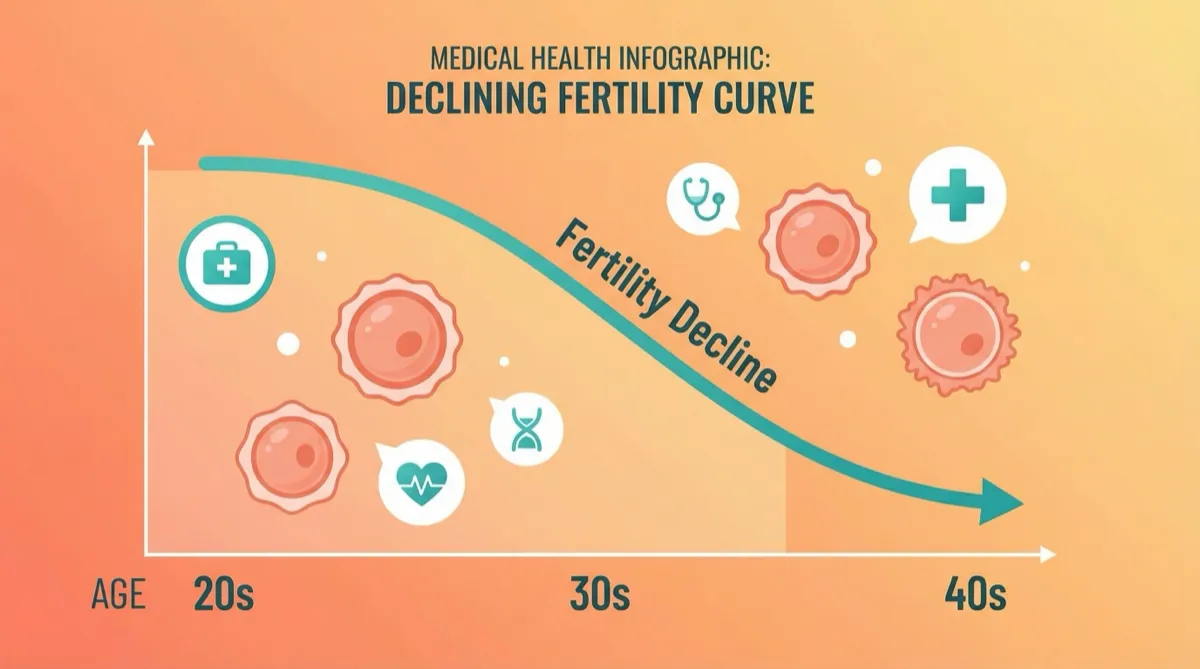
In my clinic, one of the most common conversations I have starts like this: "I know fertility declines with age, but I don't really know what the numbers are." Most women have a general sense that getting pregnant gets harder after 35. Few have seen the actual data: the per-cycle probabilities, the IVF success curves, the egg quantity estimates by age. The specifics matter. They are more nuanced than the blunt messaging most women receive.
Age is the single most significant factor in female fertility. That is not opinion. It is a biological reality driven by a finite supply of oocytes and a gradual decline in egg quality that accelerates in the mid-to-late 30s. The data does not tell a single story. It tells different stories at different ages, and those distinctions are what allow women to make informed decisions about their reproductive timelines.
Key takeaways
- Peak female fertility occurs between ages 20 and 24, with a per-cycle conception rate of approximately 25% to 30%. By age 40, that rate drops to about 5% per cycle (Dunson et al., 2002, Human Reproduction).
- The WHO estimates that approximately 1 in 6 people worldwide are affected by infertility at some point in their lives. In the U.S., about 11% of women aged 15 to 44 have impaired fecundity.
- IVF live birth rates per egg retrieval were 51.3% for women under 35 and 3.9% for women over 42, according to the CDC's 2021 ART National Summary Report.
- Egg freezing before age 35 yields significantly better outcomes: women who froze eggs at 34 or younger needed an average of 8 to 10 eggs for a 70% to 80% chance of at least one live birth (Goldman et al., 2017).
- ACOG's Committee Opinion on female age-related fertility decline states that fertility begins to decrease meaningfully in the early 30s, with a more pronounced decline after 37.
~5%
per-cycle chance of conception at age 40, down from 25% to 30% at peak fertility (ages 20-24).
Dunson et al., Human Reproduction, 2002
25-30%
Per-cycle conception rate at peak fertility (age 20-24)
Dunson et al., 2002
~5%
Per-cycle conception rate at age 40
Dunson et al., 2002
1 in 6
People worldwide affected by infertility
WHO, 2023
51.3%
IVF live birth rate, women under 35
CDC ART Report, 2021
Fertility and age at a glance
- Peak per-cycle conception rate
- 25% to 30% at ages 20-24 (Dunson et al., 2002)
- Per-cycle rate at age 40
- ~5% (Dunson et al., 2002)
- Infertility worldwide
- 1 in 6 people (WHO, 2023)
- U.S. impaired fecundity
- ~11% of women aged 15-44 (CDC)
- IVF live birth, under 35
- 51.3% per egg retrieval (CDC ART, 2021)
- IVF live birth, over 42
- 3.9% per egg retrieval (CDC ART, 2021)
How fertility changes with age
ACOG published a committee opinion on female age-related fertility decline that has been reaffirmed multiple times, most recently in 2023. The core message: fertility starts to decline gradually around age 32, more noticeably around 37, and steeply after 40.
Women are born with approximately 1 to 2 million eggs. By puberty, that number has dropped to about 300,000 to 400,000. Over a reproductive lifetime, only about 400 to 500 eggs will ovulate. The rest undergo atresia, a process of natural degeneration that is constant and irreversible, and that accelerates with age.
By age 30, a woman has roughly 12% of her original ovarian reserve. By 40, about 3%. These numbers come from histological studies and anti-Müllerian hormone (AMH) measurements across large populations. They represent averages (individual variation is substantial) but the trajectory is consistent.
Age 20-24
Peak fertility. Per-cycle conception rate ~25-30%. About 75% of eggs are chromosomally normal.
Age 30-32
Gradual decline begins. ~12% of original ovarian reserve remains. Per-cycle rate ~15-20%.
Age 35-37
Decline accelerates. ~50% of eggs chromosomally normal. Miscarriage risk rises to 20-25%. ACOG recommends fertility evaluation after 6 months of trying.
Age 40
Per-cycle rate ~5%. Only ~3% of original ovarian reserve remains. 20-30% of eggs chromosomally normal. IVF live birth rate 23.6% (age 38-40).
Age 43+
Fewer than 10% of eggs chromosomally normal. IVF live birth rate drops to 3.9% (over 42). Donor eggs become the primary path to pregnancy for most women.
Quantity is not the only thing that declines. Egg quality, meaning the likelihood that an oocyte will produce a chromosomally normal embryo, also drops with age. At 25, roughly 75% of eggs are chromosomally normal. By 35, that figure is closer to 50%. By 40, it is about 20% to 30%. By 43, fewer than 10% of eggs are chromosomally normal. That is why miscarriage rates rise sharply with maternal age: the embryo forms but cannot develop properly.
What the numbers look like cycle by cycle
The study most frequently cited on per-cycle fertility by age comes from Dunson and colleagues (Colombo and Baird), published in Human Reproduction in 2002. They analyzed 782 couples who used natural family planning methods and tracked conception rates by female age.
| Female age | Estimated probability of conception per cycle |
|---|---|
| 19-26 | ~25% to 30% |
| 27-29 | ~20% to 25% |
| 30-34 | ~15% to 20% |
| 35-39 | ~10% to 15% |
| 40+ | ~5% or less |
Source: Dunson et al. (2002), Human Reproduction
These numbers assume well-timed intercourse around ovulation. The decline from 25% at age 25 to 5% at age 40 looks gradual when presented in a table. In lived experience, it is the difference between expecting conception within a few months and facing the real possibility that it may take a year or longer, or may not happen without medical assistance.
Our ovulation calculator can help identify your most fertile window within each cycle. Timing matters at every age, but it matters more when per-cycle probability is already lower.
One detail that is often missed: the fertile window itself shortens with age. Dunson's data showed that women over 35 had a narrower range of days around ovulation when conception was possible. For women under 30, conception could occur from intercourse up to six days before ovulation. For women over 35, the effective window was closer to two to three days.
The biology behind the decline
The decline is driven by two parallel processes: fewer eggs and more chromosomal errors in the eggs that remain.
Aneuploidy (having the wrong number of chromosomes) is the primary mechanism behind both lower conception rates and higher miscarriage rates in older women. During meiosis, the chromosomes in an egg must divide evenly. As eggs age, the proteins that hold chromosomes together (cohesins) degrade. The spindle apparatus that pulls chromosomes apart during cell division becomes less precise. The result is more frequent errors: extra or missing chromosomes in the resulting egg.
Down syndrome (trisomy 21) is the most well-known consequence of age-related aneuploidy. The risk at age 25 is about 1 in 1,250. At 35, it is 1 in 350. At 40, 1 in 100. At 45, 1 in 30. But trisomy 21 is just one of many possible chromosomal errors. Most aneuploidies are not compatible with life; they end in miscarriage, often before a woman knows she is pregnant.
Miscarriage rates follow the aneuploidy curve closely: about 10% to 15% of recognized pregnancies end in miscarriage for women under 35, roughly 20% to 25% at age 35 to 39, and 35% to 50% at age 40 to 44. After 45, the miscarriage rate exceeds 50%.
Infertility prevalence worldwide
The WHO published an updated infertility fact sheet in 2023 estimating that approximately 1 in 6 people worldwide (about 17.5% of the adult population) experience infertility at some point. That figure includes both male and female factor infertility.
In the United States, the CDC reports that about 11% of women aged 15 to 44 have impaired fecundity (difficulty getting pregnant or carrying a pregnancy to term). Among women actively trying to conceive, approximately 12% to 15% will not achieve pregnancy within 12 months of regular unprotected intercourse, which is the clinical threshold for an infertility diagnosis in women under 35. For women 35 and older, the threshold is 6 months.
The causes of infertility break down roughly as follows: female factor alone accounts for about one-third of cases, male factor alone for another third, and combined or unexplained infertility for the remaining third. Age-related decline in egg quality is the single most common female factor, but it overlaps with conditions like endometriosis (present in 25% to 50% of infertile women) and ovulatory disorders including PCOS, which affects about 6% to 12% of women of reproductive age.
If your periods have become irregular, that can be an early signal of changing ovarian function. Our cycle length calculator and late period guide can help you identify patterns worth discussing with your doctor.
IVF success rates by age
The CDC publishes an annual Assisted Reproductive Technology (ART) National Summary Report, the largest and most detailed data source on IVF outcomes in the United States. The 2021 report, published in 2023, covers 413,776 ART cycles performed at 453 reporting clinics.
The relationship between maternal age and IVF success is stark:
| Patient age | Live birth rate per egg retrieval (own eggs) |
|---|---|
| Under 35 | 51.3% |
| 35-37 | 38.2% |
| 38-40 | 23.6% |
| 41-42 | 11.3% |
| Over 42 | 3.9% |
Source: CDC 2021 ART National Summary Report
These numbers require context. "Live birth rate per egg retrieval" is the most clinically meaningful metric because it captures the full path from stimulation and retrieval through to live birth. Some clinics report "pregnancy rate per transfer," which looks better on paper but excludes all the cycles where no viable embryo was available to transfer.
IVF with donor eggs tells a different story. When donor eggs from women under 35 are used, live birth rates are approximately 50% to 55% per transfer regardless of the recipient's age. This confirms that the age-related decline is primarily about egg quality, not uterine receptivity. A 42-year-old uterus can carry a pregnancy just as well as a 32-year-old uterus if the embryo is chromosomally normal.
Our IVF date calculator can help you estimate key milestones once you have begun a cycle.
Egg freezing statistics and realities
Elective egg freezing (technically oocyte cryopreservation for non-medical reasons) has grown rapidly. The Society for Assisted Reproductive Technology (SART) reported a roughly 40% increase in elective egg freezing cycles between 2019 and 2022. The majority of women freezing eggs are between 33 and 38.
The question everyone asks is: how many eggs do I need to freeze?
A 2017 study by Goldman and colleagues published in Human Reproduction developed a counseling model based on age at freeze and number of mature oocytes stored. Their estimates:
| Age at freeze | Eggs needed for ~70% chance of at least one live birth | Eggs needed for ~90% chance |
|---|---|---|
| Under 35 | 8-10 | 15-20 |
| 35-37 | 10-15 | 20-25 |
| 38-40 | 15-25 | 25-35 |
| Over 40 | 25+ | 40+ |
Source: Goldman et al. (2017), Human Reproduction
Cobo and colleagues at IVI Valencia, one of the largest fertility clinics in Europe, published data in 2016 showing that the survival rate of vitrified oocytes (eggs frozen using the rapid-freeze method now standard) was approximately 85% to 90%. Of the eggs that survived thawing, about 70% to 80% fertilized normally. But every step from thaw to live birth involves attrition, which is why you need to start with more eggs than you think.
The economics are also relevant. A single egg freezing cycle in the United States costs $6,000 to $15,000, plus $500 to $1,000 per year for storage, plus the cost of a future IVF cycle to use the eggs ($3,000 to $5,000 for the thaw and transfer). Most women under 35 can retrieve enough eggs in one cycle. Women over 37 may need two or three cycles to bank an adequate number.
Dr. Elena Rostova, Reproductive Endocrinologist
What the data does not tell you is the emotional weight of all this. The decision to freeze eggs is often made under time pressure, with incomplete information, and at significant financial cost. I have seen patients feel more in control after freezing and others stay anxious about whether they froze enough. Both responses are rational given the uncertainty.
Male age and fertility
The conversation about age and fertility focuses overwhelmingly on women, but male age matters too. The effect is smaller and slower, but it is real.
Sperm quality declines gradually after age 40. Semen volume decreases, sperm motility drops, and DNA fragmentation in sperm increases. A 2020 meta-analysis in Human Reproduction Update found that paternal age over 40 was associated with longer time to conception, lower IVF success rates, and a modestly increased risk of miscarriage.
Advanced paternal age is also associated with a small increase in the risk of certain genetic conditions in offspring, including autism spectrum disorder and schizophrenia, though the absolute risk increase is small. Unlike egg quality, sperm quality is not determined at birth (men produce new sperm continuously) but the DNA replication machinery that produces those sperm accumulates mutations over time.
The practical takeaway: male age should be part of the fertility conversation, but it does not impose the same hard biological deadline that ovarian reserve does.
What this means in practice
I try to be straightforward with patients about what the data does and does not say.
It does say that fertility declines with age, and that the decline accelerates after 35. It does say that IVF cannot fully compensate for that decline when using a woman's own eggs. It does say that egg freezing works better when done younger. These are statistical realities that hold across populations.
It does not say that any individual woman at 38 or 40 cannot get pregnant. Per-cycle probabilities are population averages, and individual outcomes vary widely based on ovarian reserve, overall health, partner factors, and the kind of variability that statistics cannot capture. I have seen 42-year-old patients conceive naturally on the first try. I have seen 29-year-olds who needed three rounds of IVF. The data describes likelihoods, not certainties.
If you are thinking about your reproductive timeline, here are specific steps that are evidence-based:
- Ask your doctor about an AMH test and antral follicle count if you are over 30 and want a baseline assessment of your ovarian reserve. These are not perfect predictors, but they provide useful information.
- If you know you want children but not now, a fertility consultation does not commit you to anything. It gives you data.
- Track your cycle. Irregular or absent periods can signal ovulatory dysfunction that is treatable. Our period calculator is a good starting point.
- If you are under 35 and have been trying for 12 months without success, or over 35 and trying for 6 months, see a reproductive endocrinologist. Waiting beyond those thresholds costs time that matters.
Frequently asked questions about fertility and age
At what age does female fertility start to decline?
ACOG's Committee Opinion on female age-related fertility decline states that fertility begins to decrease gradually in the early 30s, with a more pronounced decline after age 37. Peak fertility is between ages 20 and 24, when per-cycle conception rates are approximately 25% to 30%. By age 40, per-cycle probability drops to about 5% (Dunson et al., 2002).
What are the chances of getting pregnant at 40?
At age 40, the probability of conceiving in any given menstrual cycle is approximately 5%, assuming well-timed intercourse, based on data from Dunson et al. in Human Reproduction. Over 12 months of trying, the cumulative probability is roughly 40% to 50%. IVF with own eggs at ages 41 to 42 has a live birth rate of about 11.3% per retrieval cycle, per 2021 CDC ART data.
How many eggs should I freeze?
The number depends on your age at the time of freezing. A 2017 counseling model by Goldman et al. in Human Reproduction estimated that women under 35 need 8 to 10 mature eggs for approximately a 70% chance of at least one live birth, and 15 to 20 eggs for a 90% chance. For women aged 38 to 40, those numbers roughly double due to lower egg quality.
Does IVF work as well for older women?
IVF success rates decline significantly with maternal age when using the patient's own eggs. The CDC's 2021 ART report showed live birth rates per retrieval of 51.3% for women under 35, dropping to 11.3% for women aged 41 to 42 and 3.9% for women over 42. However, IVF with donor eggs from younger women maintains success rates of 50% to 55% regardless of the recipient's age.
How common is infertility?
The World Health Organization estimates that about 1 in 6 people worldwide experience infertility at some point. In the United States, approximately 11% of women aged 15 to 44 have impaired fecundity. Among women actively trying to conceive, 12% to 15% will not achieve pregnancy within 12 months. Causes are split roughly equally: one-third female factor, one-third male factor, one-third combined or unexplained.
Does male age affect fertility?
Yes, though the effect is smaller and more gradual than for women. After age 40, men experience declining sperm quality, reduced motility, and increased DNA fragmentation. A 2020 meta-analysis in Human Reproduction Update found that paternal age over 40 was associated with longer time to conception, lower IVF success rates, and modestly increased miscarriage risk. Unlike ovarian reserve, sperm production is continuous, so the decline does not reach the same hard limits.
Tags:FertilityAgeEgg FreezingIVFReproductive Health StatisticsWomen's Health
Sources & Citations
- American College of Obstetricians and Gynecologists. (2014, reaffirmed 2023). Committee Opinion No. 589: Female age-related fertility decline.[Source]
- CDC. (2023). 2021 Assisted Reproductive Technology National Summary Report.[Source]
- World Health Organization. (2023). Infertility fact sheet.[Source]
- Cobo A, et al. (2016). Oocyte vitrification as an efficient option for elective fertility preservation. Fertility and Sterility.[Source]
- Dunson DB, Colombo B, Baird DD. (2002). Changes with age in the level and duration of fertility in the menstrual cycle. Human Reproduction.[Source]
- Practice Committee of the American Society for Reproductive Medicine. (2024). Optimizing natural fertility: a committee opinion. Fertility and Sterility.[Source]
- Goldman RH, et al. (2017). Predicting the likelihood of live birth for elective oocyte cryopreservation: a counseling tool for physicians and patients. Human Reproduction.[Source]
Cite this page
Journalists, researchers and educators are welcome to quote these figures. Please credit Women's Health Association and link to this page so readers can reach the underlying sources.
Women's Health Association. (2026, March 1). Fertility and age: what the statistics say about reproductive timelines. Retrieved from https://www.womenshealthassoc.com/insights/fertility-age-statistics-reproductive-health
Published 2026, March 1

!
Medical Disclaimer
This content is for informational purposes only and is not a substitute for professional medical advice, diagnosis, or treatment. Always seek the advice of your physician or other qualified health provider with any questions you may have regarding a medical condition.
Keep Reading
View all articles
Reproductive Health 14 min read
Abortion access and travel distance statistics: how far U.S. patients travel after Dobbs
Mean travel time to the nearest abortion facility rose from 27.8 to 100.4 minutes after Dobbs. Here is the confirmed data on state bans, out-of-state travel volume, clinic closures, and the share of care delivered by telehealth.

Reproductive Health 15 min read
Contraception access statistics: unintended pregnancy and the gaps that remain
41.6% of U.S. pregnancies were unintended in 2019, and more than 19 million women who need publicly funded contraception live in contraceptive deserts. Here is the latest data on method use, cost, OTC pills, failure rates, and Title X capacity.

Reproductive Health 13 min read
Menstrual cycle app data privacy statistics: who tracks, what gets shared, and how often predictions miss
Nearly 1 in 3 U.S. women track fertility or periods digitally, yet audits find most popular women's mHealth apps share data with third parties. Primary figures on usage, privacy audits, prediction accuracy, FTC actions, and user trust.
Evidence in your inbox.
Join 250,000+ women receiving our weekly breakdown of new research, policy changes, and health tools.