Loading...
Cancer Prevention13 min readUpdated
Cervical cancer and HPV: what the screening and vaccination statistics tell us
HPV causes 99% of cervical cancers, and the HPV vaccine reduces cervical cancer risk by 87% in vaccinated women. Here is what the latest data says about screening, vaccination rates, and the WHO's elimination target.

Written By
Dr. Sarah Jenkins
Board Certified OB/GYN

Medically Reviewed By
Dr. Emily Chen
Chief Medical Officer
Share
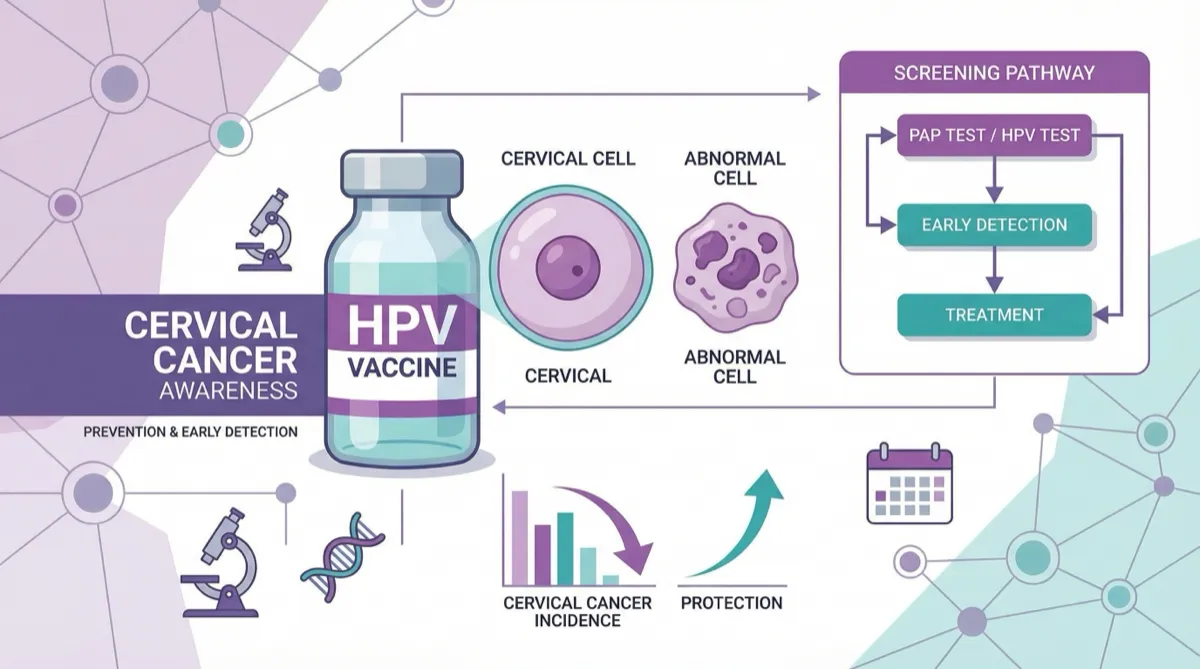
In my first year of residency, I assisted on a radical hysterectomy for a 29-year-old woman with stage IIB cervical cancer. She had never had a Pap smear. She had never been vaccinated against HPV. She did not know that HPV existed. She had a treatable infection that became a preventable precancer that became a cancer that took her uterus and, eventually, her life. She died at 31.
Cervical cancer is one of the few cancers we know exactly how to prevent. We know what causes it. We have a vaccine that is 87% effective at preventing it. We have screening tools that catch precancerous changes years before they become dangerous. And yet approximately 13,820 women in the United States will be diagnosed with invasive cervical cancer in 2025, and about 4,360 will die from it. Globally, the numbers are worse: 660,000 new cases and 350,000 deaths per year, overwhelmingly concentrated in countries with limited screening and vaccination infrastructure.
This article covers the HPV and cervical cancer numbers on vaccination and screening, and the gap between what is possible and what is actually happening.
Key takeaways
- HPV is detected in 99.7% of cervical cancers, making it a necessary cause of the disease, per a landmark 1999 study in the Journal of Pathology by Walboomers et al.
- The HPV vaccine reduces cervical cancer incidence by 87% in women vaccinated before age 17, according to a 2021 Lancet study of the English national vaccination program.
- A 2020 NEJM study of 1.7 million Swedish women found that HPV vaccination before age 17 was associated with a 88% reduction in cervical cancer risk.
- The WHO's 2020 global elimination strategy targets 90% HPV vaccination, 70% screening coverage, and 90% treatment of cervical lesions by 2030. Current global vaccination rates are approximately 21%.
- About 13,820 new cases of invasive cervical cancer and 4,360 deaths are expected in the U.S. in 2025, per the American Cancer Society.
87%
lower cervical cancer rates among women vaccinated against HPV at ages 12 to 13.
Falcaro et al., The Lancet, 2021. England national HPV vaccination programme
99%
Of cervical cancers caused by HPV
Walboomers et al., 1999
87%
Cancer reduction with HPV vaccine
Lancet, 2021
4,360
U.S. deaths expected in 2025
ACS, 2025
Cervical cancer and HPV at a glance
- HPV causation
- HPV DNA in 99.7% of cervical cancers (Walboomers et al., 1999)
- Vaccine protection, ages 12-13
- 87% lower cervical cancer rates (Falcaro et al., The Lancet, 2021)
- U.S. burden, 2025
- 13,820 new cases; 4,360 deaths (American Cancer Society)
- Survival by stage
- 92% (localized) vs 19% (distant-stage) 5-year survival (ACS)
- Screening, ages 21-65
- 73% up to date; 57% among uninsured women
- WHO elimination targets, 2030
- 90% vaccinated by 15; 70% screened by 35 and 45; 90% treated
How HPV causes cervical cancer
Human papillomavirus is the most common sexually transmitted infection in the world. The CDC estimates that about 80% of sexually active people will be infected with HPV at some point in their lives. Most infections clear on their own within one to two years. The body's immune system eliminates the virus without symptoms or lasting damage.
The problem is with the infections that don't clear. Persistent infection with high-risk HPV types, particularly HPV 16 and HPV 18, can cause cellular changes in the cervix that progress through defined stages: low-grade squamous intraepithelial lesions (LSIL), high-grade lesions (HSIL or CIN 2/3), and eventually invasive cervical cancer. That progression typically takes 10 to 20 years, which is why screening works so well. There is a long window during which precancerous changes can be detected and treated before cancer develops.
HPV 16 alone is responsible for approximately 50% of all cervical cancers. HPV 16 and HPV 18 together account for about 70%. The remaining cases are caused by a dozen other high-risk HPV types. The 1999 study by Walboomers et al. in the Journal of Pathology found HPV DNA in 99.7% of cervical cancer specimens worldwide, establishing HPV as a necessary (though not sufficient) cause of the disease.
This is important because it means cervical cancer is, in theory, entirely preventable. Prevent persistent HPV infection, and you prevent cervical cancer. That is what the vaccine does.
The global burden
Cervical cancer is the fourth most common cancer in women globally. The WHO estimated 660,000 new cases and 350,000 deaths worldwide in 2022. Roughly 90% of those deaths occurred in low- and middle-income countries, where screening programs are limited or nonexistent and HPV vaccination coverage is minimal.
In sub-Saharan Africa, cervical cancer is the leading cause of cancer death among women. In East Africa, the age-standardized incidence rate is approximately 40 per 100,000 women, about 6 times higher than in North America.
In the United States, the American Cancer Society estimates 13,820 new cases of invasive cervical cancer and 4,360 deaths in 2025. The 5-year survival rate for localized cervical cancer is about 92%. For distant-stage disease, it drops to 19%. As with breast cancer, the survival gap between early and late detection is enormous.
Cervical cancer incidence in the U.S. has declined by more than 50% since the 1970s, primarily due to widespread adoption of Pap smear screening. That decline has slowed in recent decades, and incidence has remained roughly flat since 2012. The next major reduction will likely come from the HPV vaccine, as vaccinated cohorts age into the period of highest cervical cancer risk.
| Indicator | Figure |
|---|---|
| Global new cases, 2022 | 660,000 |
| Global deaths, 2022 | 350,000 (about 90% in low- and middle-income countries) |
| U.S. new invasive cases, 2025 | 13,820 |
| U.S. deaths, 2025 | 4,360 |
| 5-year survival, localized disease | 92% |
| 5-year survival, distant-stage disease | 19% |
Source: WHO global estimates for 2022; American Cancer Society, Cancer Facts & Figures 2025.
What the HPV vaccine has changed
The HPV vaccine is one of the most effective cancer prevention tools ever developed. The data at this point is unambiguous.
A 2020 population-based study by Lei et al. published in the New England Journal of Medicine followed 1.7 million Swedish women over 11 years. Women who received the HPV vaccine before age 17 had an 88% lower incidence of cervical cancer compared to unvaccinated women. Women vaccinated between ages 17 and 30 had a 53% reduction. The protection was strongest when vaccination occurred before HPV exposure.
A 2021 study by Falcaro et al. in The Lancet evaluated the impact of England's national HPV vaccination program, which began offering the bivalent vaccine to girls aged 12 to 13 in 2008. Among women who were vaccinated at ages 12 to 13, cervical cancer rates were 87% lower than in unvaccinated cohorts. The study concluded that the HPV vaccination program had "almost eliminated" cervical cancer in women born after September 1, 1995.
Let that number settle. An 87% reduction. In a cancer that kills 350,000 women worldwide every year.
HPV vaccine: what you need to know
Gardasil 9 protects against nine HPV types responsible for ~90% of cervical cancers. The CDC recommends routine vaccination at ages 11-12, with catch-up through age 26. Adults 27-45 may benefit from shared clinical decision-making with their provider. The vaccine is most effective when given before any HPV exposure. A two-dose schedule is sufficient for those who start before age 15; three doses are recommended for those starting at 15 or older.
The current vaccine used in most countries is Gardasil 9, which protects against nine HPV types: 6, 11, 16, 18, 31, 33, 45, 52, and 58. These types collectively cause approximately 90% of cervical cancers. The CDC recommends routine vaccination at ages 11 to 12, with catch-up vaccination through age 26. In 2018, the FDA approved Gardasil 9 for adults aged 27 to 45 based on shared clinical decision-making.
Despite this, vaccination rates remain suboptimal. In the United States, about 62% of adolescents aged 13 to 17 had completed the HPV vaccine series as of 2023. That is better than a decade ago, when the rate was below 35%, but it still falls short of the Healthy People 2030 target of 80%. Vaccine hesitancy, concerns about discussing sexual health with adolescents, and inconsistent provider recommendation all contribute to the gap.
Screening guidelines and co-testing
Cervical cancer screening has evolved significantly over the past decade. The days of annual Pap smears for every woman starting at 18 are over, replaced by risk-stratified approaches that reflect what we now know about HPV biology.
Age 21
Begin cervical cancer screening with Pap smear every 3 years (USPSTF)
Age 25
ACS prefers primary HPV testing every 5 years as the preferred approach starting at this age
Age 30
Switch to Pap + HPV co-testing every 5 years, or HPV primary testing every 5 years (USPSTF)
Age 40
Continue cervical screening per schedule; also begin biennial mammography screening (USPSTF, 2024 update)
Age 65
May stop cervical screening if adequate prior screening with normal results and no history of CIN 2+ in past 25 years
The current USPSTF recommendation (2018, reaffirmed) offers three options for average-risk women:
- Pap smear (cervical cytology) every 3 years for women aged 21 to 65
- HPV testing alone every 5 years for women aged 30 to 65
- Co-testing (Pap smear plus HPV test) every 5 years for women aged 30 to 65
| Screening method | Ages | Frequency | Sensitivity for CIN 2+ | Recommended by |
|---|---|---|---|---|
| Pap smear alone | 21-65 | Every 3 years | ~85% | USPSTF |
| HPV primary testing | 25-65 (ACS) / 30-65 (USPSTF) | Every 5 years | ~92% | ACS (preferred), USPSTF |
| Co-testing (Pap + HPV) | 30-65 | Every 5 years | ~95% | USPSTF, ACS (acceptable) |
The American Cancer Society updated its guidelines in 2020 to recommend primary HPV testing alone every 5 years as the preferred approach starting at age 25. If primary HPV testing is not available, co-testing every 5 years or Pap smear every 3 years are acceptable alternatives.
Co-testing (performing both a Pap smear and an HPV test at the same visit) has the highest sensitivity for detecting cervical precancer. The combination catches approximately 95% of high-grade cervical lesions, compared to about 85% for Pap smear alone. For women over 30, the negative predictive value of a combined normal Pap and negative HPV test is greater than 99%, which is why the 5-year screening interval is considered safe.
For women under 30, HPV testing alone is generally not recommended because HPV infections are so common in this age group that positive results would trigger excessive follow-up procedures. Most HPV infections in young women clear spontaneously, and overtesting leads to unnecessary colposcopies and biopsies.
If you are tracking your reproductive health, understanding your cycle patterns is also relevant. Our period calculator can help establish baseline awareness alongside your cervical screening schedule.
Who is being screened and who is not
In the United States, approximately 73% of women aged 21 to 65 are up to date on cervical cancer screening. That means roughly 1 in 4 women are not.
Screening rates are lowest among women who are uninsured (about 57%), women who have not seen a doctor in the past year, women in rural areas, and women aged 21 to 29 (who often fall out of the healthcare system between aging off their parents' insurance and establishing their own care). Immigrant women, particularly those from countries without organized screening programs, also have lower rates.
The Affordable Care Act requires insurance plans to cover cervical cancer screening without cost-sharing. But for the roughly 26 million Americans who remain uninsured, the cost of an office visit plus a Pap smear can be a barrier. The CDC's National Breast and Cervical Cancer Early Detection Program provides free screening to low-income, uninsured women, but program capacity is limited and awareness is low.
Self-collection HPV testing, in which women collect their own vaginal sample at home, is one way to lower screening barriers. Studies have shown that self-collected samples have comparable sensitivity to clinician-collected samples for HPV detection. The FDA has not yet approved a self-collection HPV test for the U.S. market as of early 2026, but Australia, the Netherlands, and England have already integrated self-collection into their national screening programs with positive results.
Racial and geographic disparities
Cervical cancer incidence and mortality in the United States follow familiar patterns of inequity.
Hispanic women have the highest cervical cancer incidence rate of any racial or ethnic group in the U.S., at approximately 9.2 per 100,000. Black women have the highest mortality rate, at roughly 3.4 per 100,000, compared to 1.8 per 100,000 for white women. The mortality disparity is driven by later stage at diagnosis, lower screening rates, and reduced access to timely follow-up after abnormal results.
Geographic disparities are equally stark. Cervical cancer incidence in the rural South is approximately 50% higher than in urban areas of the Northeast. Appalachian counties in particular have cervical cancer mortality rates that are among the highest in the nation, driven by limited access to OB/GYNs, low screening uptake, and lower HPV vaccination coverage.
Among American Indian and Alaska Native women, cervical cancer incidence is approximately twice that of white women. These communities face compounding barriers: geographic isolation, underfunded Indian Health Service facilities, and cultural factors that may affect willingness to undergo cervical screening.
These disparities are not about biology. They are about who gets screened, who gets followed up, and who gets treated on time. For more on how health disparities affect women's care, our article on endometriosis diagnosis delays covers similar systemic patterns.
| Population / comparison | Rate reported in article |
|---|---|
| Hispanic women, incidence (highest of any U.S. racial/ethnic group) | 9.2 per 100,000 |
| Black women, mortality (highest in U.S.) | 3.4 per 100,000 |
| White women, mortality | 1.8 per 100,000 |
| American Indian / Alaska Native women, incidence | ~2× white women |
| Rural South vs urban Northeast, incidence | ~50% higher in rural South |
| East Africa, age-standardized incidence | ~40 per 100,000 (about 6× North America) |
Source: American Cancer Society, Cancer Facts & Figures 2025 and WHO global estimates as cited in article prose.
The WHO elimination strategy
In November 2020, the WHO adopted a global strategy to eliminate cervical cancer as a public health problem. "Elimination" in this context means reducing the incidence to below 4 per 100,000 women. The strategy sets three targets for 2030:
- 90% of girls fully vaccinated with the HPV vaccine by age 15
- 70% of women screened with a high-performance test by ages 35 and 45
- 90% of women with cervical disease receiving treatment
Current progress is mixed. Global HPV vaccination coverage for the last dose among girls aged 9 to 14 was approximately 21% in 2023. That is far from the 90% target. Coverage varies enormously: above 80% in countries like Australia and Rwanda; below 5% in much of sub-Saharan Africa and South Asia.
Australia is the country closest to cervical cancer elimination. Its national vaccination program, combined with organized screening, has reduced cervical cancer incidence to below 6 per 100,000 and is projected to reach the elimination threshold of 4 per 100,000 by the early 2030s. Australia began vaccinating girls in 2007 and added boys in 2013.
In low-income countries, where 90% of cervical cancer deaths occur, scale-up of vaccination has been slow. Gavi, the Vaccine Alliance, provides subsidized HPV vaccines to eligible countries, but supply constraints, delivery logistics, and the challenges of reaching adolescent girls outside the school system have slowed rollout. The WHO's 2030 targets are ambitious. Meeting them will require a pace of scale-up that current trajectories do not support.
What comes next
The tools to eliminate cervical cancer exist. They have existed for over a decade. The gap is implementation.
- If you are a parent of a child aged 9 to 14: talk to your pediatrician about the HPV vaccine. It is most effective when given before any HPV exposure. The CDC recommends starting at age 11 or 12, with a two-dose schedule for those who begin before age 15.
- If you are between 21 and 65: confirm that your cervical cancer screening is up to date. If you are over 30, ask your doctor about co-testing (Pap plus HPV test) or primary HPV testing.
- If you are 27 to 45 and were never vaccinated: the HPV vaccine can still provide protection. Discuss with your provider whether catch-up vaccination is appropriate for you.
- If you have had an abnormal Pap or HPV result: follow up. Do not let it fall through the cracks. The progression from precancer to cancer takes years, but only if it is monitored and treated.
For additional reproductive health tools, our ovulation calculator and health resources page can support your broader health planning.
Frequently asked questions about cervical cancer and HPV
What percentage of cervical cancers are caused by HPV?
HPV is detected in 99.7% of cervical cancers worldwide, per a landmark 1999 study by Walboomers et al. in the Journal of Pathology. HPV types 16 and 18 together cause approximately 70% of cases. Gardasil 9 covers nine HPV types responsible for about 90% of cervical cancers.
How effective is the HPV vaccine at preventing cervical cancer?
A 2021 Lancet study of England's national vaccination program found an 87% reduction in cervical cancer among women vaccinated at ages 12 to 13. A 2020 New England Journal of Medicine study of 1.7 million Swedish women found an 88% reduction when vaccination occurred before age 17. The vaccine is most effective when given before HPV exposure.
How often should I get screened for cervical cancer?
The USPSTF recommends Pap smears every 3 years for women aged 21 to 65, or co-testing (Pap plus HPV test) every 5 years for women aged 30 to 65, or primary HPV testing alone every 5 years for women 30 to 65. The American Cancer Society prefers primary HPV testing every 5 years starting at age 25.
Can you still get cervical cancer if you have been vaccinated?
Yes, but the risk is dramatically lower. The HPV vaccine does not cover all cancer-causing HPV types, so approximately 10% of cervical cancers are caused by types not in the vaccine. This is why continued screening is recommended even for vaccinated women. Screening catches the small number of precancers that the vaccine does not prevent.
What is the WHO's cervical cancer elimination target?
The WHO's 2020 global strategy defines elimination as reducing cervical cancer incidence below 4 per 100,000 women. The strategy targets 90% HPV vaccination of girls by age 15, 70% screening coverage by ages 35 and 45, and 90% treatment of cervical lesions by 2030. Australia is the country closest to meeting the elimination threshold.
Why do Black women have higher cervical cancer death rates?
Black women in the U.S. have a cervical cancer mortality rate roughly 1.9 times that of white women. The disparity is driven by lower screening rates, delayed follow-up after abnormal results, later stage at diagnosis, and reduced access to timely treatment. Incidence is highest among Hispanic women, but mortality is highest among Black women due to treatment access inequities.
Tags:Cervical CancerHPVCancer ScreeningCancer PreventionWomen's Health StatisticsVaccination
Sources & Citations
- Walboomers JMM, et al. (1999). Human papillomavirus is a necessary cause of invasive cervical cancer worldwide. Journal of Pathology, 189(1), 12–19.[Source]
- Lei J, et al. (2020). HPV vaccination and the risk of invasive cervical cancer. New England Journal of Medicine, 383(14), 1340–1348.[Source]
- Falcaro M, et al. (2021). The effects of the national HPV vaccination programme in England, UK, on cervical cancer and grade 3 cervical intraepithelial neoplasia incidence: a register-based observational study. The Lancet, 398(10316), 2084–2092.[Source]
- WHO. (2020). Global strategy to accelerate the elimination of cervical cancer as a public health problem.[Source]
- American Cancer Society. (2025). Cancer Facts & Figures 2025.[Source]
- USPSTF. (2018). Final recommendation statement: Cervical cancer screening.[Source]
- CDC. (2024). HPV vaccination recommendations.[Source]
Cite this page
Journalists, researchers and educators are welcome to quote these figures. Please credit Women's Health Association and link to this page so readers can reach the underlying sources.
Women's Health Association. (2026, March 1). Cervical cancer and HPV: what the screening and vaccination statistics tell us. Retrieved from https://www.womenshealthassoc.com/insights/cervical-cancer-hpv-screening-statistics
Published 2026, March 1

!
Medical Disclaimer
This content is for informational purposes only and is not a substitute for professional medical advice, diagnosis, or treatment. Always seek the advice of your physician or other qualified health provider with any questions you may have regarding a medical condition.
Keep Reading
View all articles
Reproductive Health 14 min read
Abortion access and travel distance statistics: how far U.S. patients travel after Dobbs
Mean travel time to the nearest abortion facility rose from 27.8 to 100.4 minutes after Dobbs. Here is the confirmed data on state bans, out-of-state travel volume, clinic closures, and the share of care delivered by telehealth.

Mental Health 14 min read
ADHD in women and girls statistics: the late-diagnosis gap in plain numbers
Girls are diagnosed with ADHD at roughly half the rate of boys, yet more than half of U.S. adults with ADHD were first diagnosed at 18 or older. Here is the CDC, NCHS, and peer-reviewed data on sex gaps, adult diagnosis, age at identification, presentation differences, stimulant shortages, and comorbidity.

Chronic Conditions 12 min read
Alzheimer's dementia statistics in women: why two-thirds of patients are female
Almost two-thirds of Americans with Alzheimer's are women. Lifetime risk at 45 is about 1 in 5 for women versus 1 in 10 for men. Here is what the data says about prevalence, caregiving, APOE4, diagnosis delays, and cost of care.
Evidence in your inbox.
Join 250,000+ women receiving our weekly breakdown of new research, policy changes, and health tools.