Loading...
Women's Wellness13 min readUpdated
Women's healthcare access statistics: who falls through the gaps
36% of U.S. counties have no hospital obstetric services. Here is what the data says about insurance gaps, maternity care deserts, and the cost barriers keeping millions of women from basic care.

Written By
Dr. Emily Chen
Chief Medical Officer

Medically Reviewed By
Dr. Sarah Jenkins
Board Certified OB/GYN
Share
In 2023, a pregnant woman in rural Mississippi drove 90 minutes each way for her prenatal appointments. There was no OB/GYN within her county. No hospital with a labor and delivery unit, either. When her water broke at 36 weeks, she delivered in the car on the highway shoulder while her husband called 911.
Her story is extreme but not rare. Women's healthcare access in the United States is shaped by geography, income, insurance status, and race in ways that produce measurable and preventable harm. The data on who can get care and who cannot is not ambiguous. It is specific, well-documented, and it has not improved fast enough. Progress has been slow.
Key takeaways
- Before the Affordable Care Act, 28 million women in the U.S. were uninsured. That number dropped to roughly 10.7 million by 2023, but coverage gaps persist in states that have not expanded Medicaid (KFF, 2024).
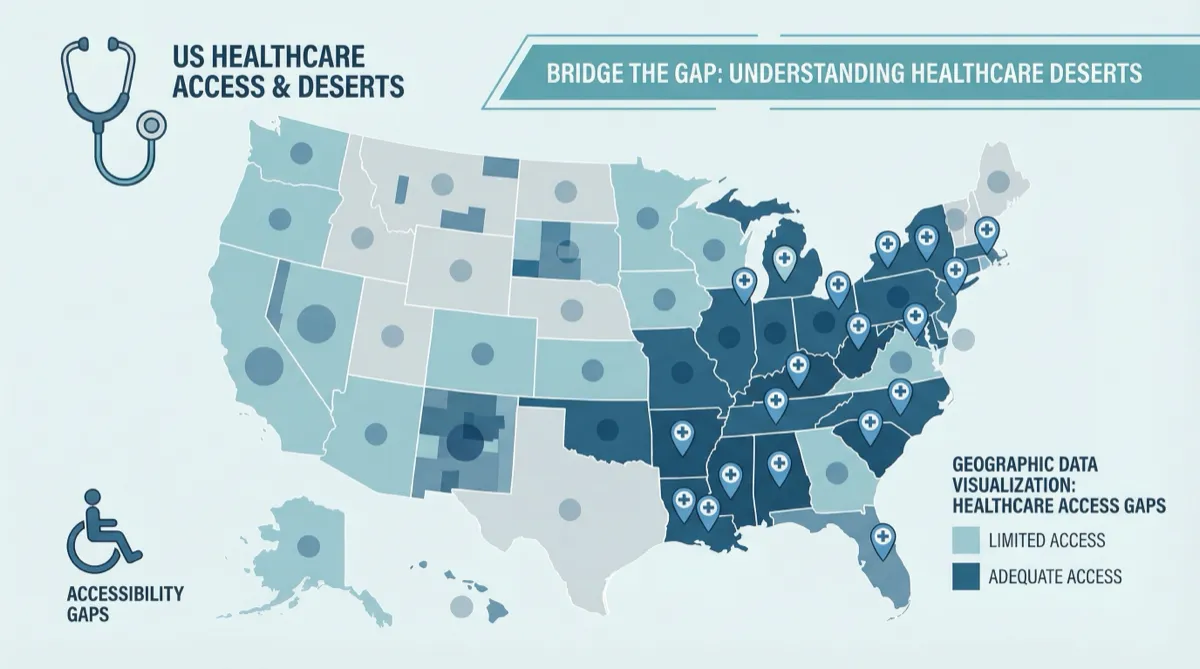
- 36% of U.S. counties have no hospital with obstetric services. The March of Dimes classifies over 1,100 counties as maternity care deserts.
- Medicaid finances approximately 42% of all births in the United States, making it the single largest payer for maternity care (MACPAC, 2024).
- Women in rural areas are 60% more likely to travel more than 30 minutes to reach an OB/GYN or certified nurse-midwife compared to women in urban areas (HRSA, 2024).
- The U.S. maternal mortality rate was 22.3 per 100,000 live births in 2022, more than double the rate in peer nations like the United Kingdom and France (Commonwealth Fund, 2024).
36%
of U.S. counties have no hospital with obstetric services. More than 1,100 counties are classified as maternity care deserts.
March of Dimes, Maternity Care Deserts Report, 2024
10.7M
Women uninsured (2023)
KFF, 2024
36%
Counties with no obstetric services
March of Dimes, 2024
42%
U.S. births financed by Medicaid
MACPAC, 2024
22.3
Maternal deaths per 100,000 births
CDC, 2025
Women's healthcare access at a glance
- Women uninsured, 2023
- 10.7 million (KFF, 2024)
- Counties with no obstetric services
- 36%, more than 1,100 maternity care deserts (March of Dimes, 2024)
- Women of childbearing age in deserts
- More than 2.2 million (March of Dimes, 2024)
- U.S. births financed by Medicaid
- 42% (MACPAC, 2024)
- Rural travel barrier
- 60% more likely than urban women to travel >30 minutes to an OB/GYN (HRSA, 2024)
- Maternal mortality, 2022
- 22.3 per 100,000 live births (CDC / Commonwealth Fund, 2024)
The insurance gap
Insurance is the most basic access question.
Without it, routine care becomes unaffordable. Preventive screening gets skipped. Chronic conditions go unmanaged until they become emergencies.
Before the ACA took effect in 2014, approximately 28 million women in the United States lacked health insurance. The law changed the picture substantially. Medicaid expansion, marketplace subsidies, and the requirement that insurers cover maternity care and preventive services like mammograms and contraception without cost-sharing brought the uninsured rate for women down to a historic low of about 10.7 million by 2023.
But coverage is uneven. In the 10 states that still have not adopted Medicaid expansion as of 2025, uninsured rates for women of reproductive age are roughly double those in expansion states. According to KFF, 30% of uninsured women of childbearing age live in Texas alone. Mississippi, which has one of the worst maternal mortality rates in the country, did not expand Medicaid until 2024.
Being insured does not mean being well-covered. A 2024 KFF survey found that 43% of insured women reported difficulty affording out-of-pocket costs, including deductibles and copays for prescriptions. High-deductible health plans have grown from 19% of employer-sponsored coverage in 2009 to 29% in 2024. They force women to pay more before insurance kicks in.
Maternity care deserts
The March of Dimes has been tracking maternity care deserts since 2018. The most recent report, released in 2024, identified more than 1,100 U.S. counties (about 36% of the total) that have no hospital offering obstetric services, no birth center, and no OB/GYN or certified nurse-midwife. Another 300+ counties qualify as "low access," meaning they have some but not adequate resources.
More than 2.2 million women of childbearing age live in these deserts.
Between 2004 and 2023, about 270 rural hospitals closed their obstetric units. The closures accelerated after 2010, driven by low birth volumes, staffing shortages, and financial pressure from caring for a disproportionately Medicaid-covered population. When a unit closes, women do not simply appear at the next nearest hospital with everything they need. They face longer drive times, higher preterm birth rates, and a greater likelihood of unattended delivery.
ACOG has documented that women living in maternity care deserts have significantly higher rates of preterm birth, low birthweight babies, and maternal complications. A 2023 analysis published in Obstetrics & Gynecology found that county-level loss of obstetric services was associated with a 4.4% increase in preterm births within three years of closure.
If you are pregnant or planning a pregnancy and are unsure of your options, our period calculator and IVF date calculator can help you track timing. The bigger question, whether there is a hospital with delivery services within driving distance, requires checking your local resources.
Medicaid and the coverage cliff
Medicaid pays for 42% of all births in the United States. In some states, that figure exceeds 60%. It is the backbone of maternity care for low-income women, and it has a structural flaw that creates a dangerous coverage gap.
Under federal law, Medicaid covers pregnant women through 60 days postpartum. After that, coverage ends. The American Rescue Plan Act of 2021 gave states the option to extend postpartum Medicaid coverage to 12 months, and as of early 2025, 46 states and the District of Columbia have adopted that extension. But in the remaining states, women lose their health insurance less than two months after giving birth.
That matters because more than half of pregnancy-related deaths occur between 7 days and one year postpartum, according to CDC Maternal Mortality Review Committee data. The leading causes are cardiomyopathy, mental health conditions, and hemorrhage. They often emerge or worsen weeks to months after delivery, and losing insurance coverage during this period removes the safety net at exactly the wrong time.
The postpartum coverage cliff
More than half of pregnancy-related deaths occur between 7 days and one year postpartum (CDC). In states that have not extended Medicaid to 12 months, women lose coverage at 60 days, during the highest-risk window.
For the 42% of births covered by Medicaid, the coverage cliff is not theoretical. It is a direct contributor to maternal mortality. States that extended postpartum coverage saw a measurable increase in postpartum visit attendance and a reduction in coverage gaps during the critical first year.
Cost as a barrier to care
Even among insured women, cost prevents care. This is not perception. It shows up as skipped appointments, unfilled prescriptions, and delayed diagnoses.
A 2024 KFF Women's Health Survey found that 29% of women reported delaying or forgoing medical care in the past year due to cost. The rate was higher among Black women (38%), Hispanic women (36%), and women with household incomes below $40,000 (44%). Dental care and prescriptions were the most commonly delayed, followed by specialist visits including gynecological care.
The cost of a routine gynecological visit without insurance runs $150 to $350, depending on location. A mammogram costs $100 to $250. An IUD insertion costs $500 to $1,300. Contraception, which the ACA requires insurers to cover without cost-sharing, is still not consistently available at no cost due to exemptions for certain employers and gaps in plan design.
The result is a two-tier system. Women with employer-sponsored insurance from large companies receive preventive care on schedule. Women on Medicaid, women on marketplace plans with high deductibles, and uninsured women make rationing decisions that clinicians rarely see. Those decisions surface only when complications develop.
The provider shortage in women's health
There are not enough OB/GYNs. ACOG estimates that the United States is short approximately 9,000 OB/GYN physicians relative to need, and the gap is projected to widen to 22,000 by 2050 as current practitioners retire faster than new ones enter the field.
HRSA data shows that more than half of U.S. counties have no practicing OB/GYN at all. The shortage concentrates in rural areas and in states with lower Medicaid reimbursement rates, which make it financially difficult for providers to sustain a practice that serves a high proportion of Medicaid patients.
Certified nurse-midwives and advanced practice nurses fill some of the gap, but scope-of-practice laws vary dramatically by state. In some states, nurse-midwives can practice independently. In others, they must have a collaborative agreement with a physician, which is impossible to arrange if there is no physician in the area.
The provider shortage intersects with the maternity care desert problem. When the only OB/GYN in a county retires and is not replaced, the hospital often closes its obstetric unit because there is no one to staff it. The loss cascades: fewer births attract fewer nurses, which makes the unit less financially viable, which accelerates closure. Our health resources page includes information on finding providers in underserved areas.
Rural versus urban divides
Rural women in the United States face a distinct set of access challenges that compound every metric discussed above. They are more likely to be uninsured, more likely to live in a maternity care desert, more likely to travel long distances for specialty care, and more likely to experience a pregnancy complication.
According to HRSA, women in rural areas are 60% more likely than urban women to travel more than 30 minutes to reach an OB/GYN. For specialty care (reproductive endocrinology, maternal-fetal medicine) the distances can exceed 100 miles. Telehealth has helped for some services, but prenatal ultrasounds, lab work, and delivery itself cannot be done remotely.
Rural maternal mortality is higher than urban maternal mortality. A CDC analysis found that pregnancy-related death rates in rural counties were 41.4 per 100,000 live births compared to 21.8 per 100,000 in large urban counties. Part of that reflects delays in reaching emergency care, part reflects the higher burden of chronic conditions like obesity and diabetes in rural populations, and part reflects fewer resources for managing high-risk pregnancies.
The closure of rural hospitals has worsened the picture. Since 2010, more than 150 rural hospitals have closed entirely, and many more have eliminated specific services including obstetrics, emergency care, and surgery. The women who live in these communities do not relocate. They simply have fewer options.
Race, income, and compounding disadvantage
The access disparities described above do not fall evenly across racial and economic groups. They compound.
| Group | Maternal mortality rate (per 100,000) | Late/no prenatal care |
|---|---|---|
| White women | 19.0 | 4% |
| Black women | 49.5 | 10% |
| American Indian / Alaska Native | ~46 | 12% |
| Hispanic women | 16.9 | 9% |
Source: CDC, Maternal Mortality Rates in the United States, 2023 (CDC, 2025).
Black women are three times more likely to die from pregnancy-related causes than white women. The CDC's 2023 data recorded a maternal mortality rate of 49.5 per 100,000 live births for Black women compared to 19.0 for white women. That gap has persisted for decades and narrowed only slightly between 2021 and 2023.
American Indian and Alaska Native women have the second-highest maternal mortality rate at approximately 46 per 100,000. Hispanic women have lower overall mortality rates but face disproportionate barriers to prenatal care access, with 9% receiving late or no prenatal care compared to 4% of white women.
Income amplifies racial disparities. A Black woman earning below the federal poverty line in a rural, non-expansion Medicaid state faces overlapping barriers: no insurance, no nearby provider, limited transportation, and a healthcare system with well-documented biases in how it treats her pain. Each barrier alone is manageable. Together, they produce the maternal mortality rate that makes the United States an outlier among wealthy nations.
The Commonwealth Fund's 2024 comparison of women's health across 11 high-income countries ranked the United States last on multiple measures, including maternal mortality, access to care, and affordability. The U.S. spent more per capita on healthcare than any country in the comparison. The outcomes did not reflect the spending.
| Country | Maternal mortality rate (per 100,000 live births) |
|---|---|
| United States | 22.3 |
| United Kingdom | 9.7 |
| France | 8.1 |
| Germany | 4.8 |
Source: Commonwealth Fund, U.S. Women's Health Compared to Ten Other Countries, 2024. The U.S. rate is more than double any peer nation shown.
If you are experiencing symptoms that affect your menstrual cycle or reproductive health, tracking those patterns is a first step toward seeking care. Our guide on late periods and late period tool can help you identify whether something warrants a clinical visit.
What policy changes have helped
The picture is not entirely bleak. Several policy interventions have produced measurable improvements in access, and they offer a template for what works.
Medicaid expansion. States that expanded Medicaid under the ACA saw a 30% reduction in uninsured rates among women of reproductive age. Expansion states also saw lower rates of severe maternal morbidity and better prenatal care utilization compared to non-expansion states.
Postpartum Medicaid extension. The 46 states that extended coverage to 12 months postpartum have seen higher rates of postpartum visit attendance and continued management of conditions like hypertension and depression that emerge after delivery.
Telehealth expansion. The pandemic-era loosening of telehealth restrictions improved access to prenatal care, mental health services, and medication management. Rural women were the primary beneficiaries. Some of those flexibilities became permanent through CMS rulemaking in 2023 and 2024.
Maternal health programs. The Momnibus Act, portions of which have been funded and implemented since 2022, directs investment into maternal mortality review committees, implicit bias training, community-based doula programs, and perinatal quality collaboratives. The evidence for doula support is particularly strong: women with doula care have lower rates of cesarean delivery, preterm birth, and postpartum depression.
What has not happened is systemic reform of how we distribute providers, fund rural hospitals, or address the Medicaid reimbursement rates that make it financially untenable for doctors to practice in high-need areas. Those are structural problems that require structural solutions.
Frequently asked questions about women's healthcare access
How many women in the U.S. are uninsured?
Approximately 10.7 million women in the United States lacked health insurance as of 2023, according to KFF. Before the Affordable Care Act took effect in 2014, that number was about 28 million. Uninsured rates remain highest in states that have not expanded Medicaid, where women of reproductive age are roughly twice as likely to be uninsured.
What is a maternity care desert?
A maternity care desert is a county with no hospital obstetric services, no birth center, and no OB/GYN or certified nurse-midwife. The March of Dimes identified more than 1,100 U.S. counties meeting this definition in 2024, representing about 36% of all counties. Over 2.2 million women of childbearing age live in these areas.
Why is the maternal mortality rate so high in the United States?
The U.S. maternal mortality rate was 22.3 per 100,000 live births in 2022, more than double the rate in peer nations. Contributing factors include insurance coverage gaps, maternity care deserts, high rates of chronic conditions like obesity and hypertension, racial disparities in care quality, and the Medicaid postpartum coverage cliff. Black women are three times more likely to die from pregnancy-related causes than white women.
Does Medicaid cover pregnancy?
Yes. Medicaid covers prenatal care, labor and delivery, and postpartum care. It finances approximately 42% of all births in the United States. As of 2025, 46 states have extended postpartum Medicaid coverage from 60 days to 12 months. However, eligibility varies by state, and coverage gaps can still occur after the postpartum period ends in states that have not expanded Medicaid broadly.
How far do rural women travel for obstetric care?
Women in rural areas are 60% more likely than urban women to travel more than 30 minutes to reach an OB/GYN or certified nurse-midwife, according to HRSA data. For subspecialty care like maternal-fetal medicine, travel distances in rural areas can exceed 100 miles. More than half of U.S. counties have no practicing OB/GYN.
What policy changes have improved women's healthcare access?
The changes with the strongest evidence include Medicaid expansion under the ACA (which reduced uninsured rates among reproductive-age women by 30% in expansion states), the extension of postpartum Medicaid coverage to 12 months in 46 states, telehealth expansion for prenatal and mental health services, and investments in community-based doula programs through the Momnibus Act. Doula-supported births show lower rates of cesarean delivery and preterm birth.
Tags:Healthcare AccessHealth DisparitiesMaternal HealthInsurance CoverageWomen's Health StatisticsRural Health
Sources & Citations
- KFF. (2024). Women's Health Insurance Coverage.[Source]
- March of Dimes. (2024). Maternity Care Deserts Report.[Source]
- Medicaid and CHIP Payment and Access Commission. (2024). Births Financed by Medicaid.[Source]
- HRSA. (2024). Maternal Health: Health Workforce Shortage Areas.[Source]
- CDC. (2025). Maternal Mortality Rates in the United States, 2023.[Source]
- ACOG. (2024). Geographic Disparities in Access to Hospital-Based Obstetric Care.[Source]
- Commonwealth Fund. (2024). U.S. Women's Health Compared to Ten Other Countries.[Source]
Cite this page
Journalists, researchers and educators are welcome to quote these figures. Please credit Women's Health Association and link to this page so readers can reach the underlying sources.
Women's Health Association. (2026, March 1). Women's healthcare access statistics: who falls through the gaps. Retrieved from https://www.womenshealthassoc.com/insights/womens-healthcare-access-statistics-disparities
Published 2026, March 1

!
Medical Disclaimer
This content is for informational purposes only and is not a substitute for professional medical advice, diagnosis, or treatment. Always seek the advice of your physician or other qualified health provider with any questions you may have regarding a medical condition.
Keep Reading
View all articles
Women's Wellness 13 min read
Breast cancer screening statistics: what the survival data actually tells us
The 5-year survival rate for breast cancer caught early is 99%. Caught late, it drops to 31%. Here is what the latest screening, incidence, and disparity data tells us about where we stand and what still needs to change.
Women's Wellness 12 min read
Iron deficiency in women: what the statistics say about the most common nutritional gap
Nearly 30% of reproductive-age women worldwide are anemic, and women are 5x more likely than men to be iron deficient. Here is what the data says about symptoms, thresholds, and why so many cases are missed.
Women's Wellness 14 min read
Menopause and hormone therapy statistics: what the data says about HRT in 2026
About 1.3 million U.S. women enter menopause each year, but only 4-5% of eligible women use hormone therapy. Here is what the WHI study actually found, what has changed since, and why the treatment gap persists.
Evidence in your inbox.
Join 250,000+ women receiving our weekly breakdown of new research, policy changes, and health tools.