Loading...
Women's Wellness14 min readUpdated
Menopause and hormone therapy statistics: what the data says about HRT in 2026
About 1.3 million U.S. women enter menopause each year, but only 4-5% of eligible women use hormone therapy. Here is what the WHI study actually found, what has changed since, and why the treatment gap persists.

Written By
Dr. Sarah Jenkins
Board Certified OB/GYN

Medically Reviewed By
Dr. Elena Rostova
Reproductive Endocrinologist
Share
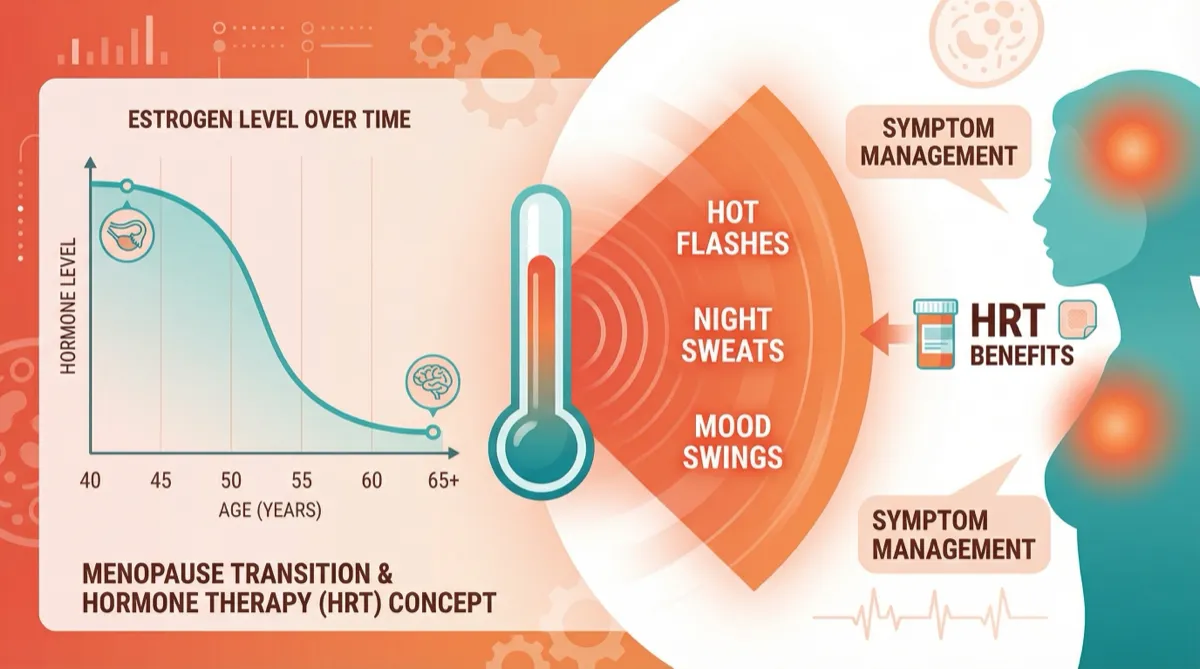
In the late 1990s, roughly 40% of postmenopausal women in the United States used hormone replacement therapy. By 2010, that number had dropped below 5%. The decline was not driven by a change in menopause biology. It was driven by a single study, the Women's Health Initiative, and the way its results were communicated to the public.
Two decades later, the medical understanding of hormone therapy has evolved. The data is more nuanced than the initial headlines suggested. Prescribing patterns have barely recovered. Millions of women with debilitating menopause symptoms go untreated because of a risk perception that is, for many of them, outdated.
Here is what the evidence shows about menopause, hormone therapy, and the gap between what guidelines support and what women actually receive.
Key takeaways
- Approximately 1.3 million U.S. women enter menopause each year, with an average onset age of 51 (The Menopause Society).
- Vasomotor symptoms (hot flashes and night sweats) affect roughly 80% of menopausal women, with 25% experiencing severe symptoms.
- Only about 4% to 5% of eligible menopausal women in the U.S. currently use hormone therapy, down from a peak of roughly 40% before the 2002 WHI publication.
- A 2015 analysis in the American Journal of Public Health estimated that estrogen avoidance after the WHI may have contributed to 18,600 to 91,600 excess deaths among hysterectomized women aged 50 to 59 over a 10-year period.
- The 2022 Menopause Society position statement affirms that hormone therapy is the most effective treatment for vasomotor symptoms and recommends it for symptomatic women under 60 or within 10 years of menopause onset.
4-5%
of eligible menopausal women in the U.S. currently use hormone therapy, down from roughly 40% before the 2002 WHI publication.
The Menopause Society, 2022; pre-WHI peak cited in article
1.3M
U.S. women enter menopause annually
The Menopause Society
80%
Experience vasomotor symptoms
SWAN Study
4-5%
Of eligible women currently use HRT
Menopause Society, 2022
Menopause and HRT at a glance
- U.S. women entering menopause yearly
- About 1.3 million (The Menopause Society)
- Average age of natural menopause
- 51 years
- Postmenopausal women in the U.S.
- Estimated 55 million
- Vasomotor symptoms
- ~80% of menopausal women; 25% severe
- Current HRT use (eligible women)
- Roughly 4% to 5% (down from ~40% pre-WHI)
- Median duration of hot flashes
- 7.4 years (SWAN study)
Menopause by the numbers
Menopause is defined as 12 consecutive months without a menstrual period. That definition marks the end of ovarian function. The average age of natural menopause in the United States is 51, though the transition (perimenopause) typically begins in the mid-40s and can last 4 to 8 years.
About 1.3 million American women reach menopause each year. At any given time, an estimated 55 million women in the U.S. are postmenopausal. Globally, the number is roughly 1 billion, and it is projected to reach 1.2 billion by 2030 as the world's population ages.
These are not small populations. Menopause is a universal biological event for women who live long enough. Still, research funding, clinical training, and treatment access remain thin relative to conditions that affect comparable numbers.
Perimenopause (mid-40s)
Hormonal fluctuations begin. Cycles become irregular, vasomotor symptoms may start. Lasts 4-8 years on average. Bone density loss accelerates as estrogen declines.
Menopause (avg. age 51)
Defined as 12 consecutive months without a period. Marks the end of ovarian function. Vasomotor symptoms typically peak. Median duration of hot flashes: 7.4 years (SWAN study).
Postmenopause
The years after menopause. Bone loss continues at 0.5-1% per year. Cardiovascular risk rises. Genitourinary syndrome of menopause (vaginal dryness, urinary symptoms) worsens over time without treatment.
Premature menopause (before age 40) affects about 1% of women. Early menopause (before age 45) affects about 5%. Both carry elevated risks for cardiovascular disease and osteoporosis, as well as higher all-cause mortality. Hormone therapy is particularly important in these populations.
If you are experiencing cycle changes in your 40s, our perimenopause guide covers the symptoms and timeline in detail.
What the WHI study actually found
The Women's Health Initiative is arguably the most consequential clinical trial in women's health history. It is also one of the most misunderstood.
Launched in 1991, the WHI enrolled more than 160,000 postmenopausal women. The hormone therapy component was a randomized controlled trial comparing combined estrogen plus progestin (in women with a uterus) and estrogen alone (in women who had undergone hysterectomy) against placebo. The combined estrogen-progestin arm was stopped early in July 2002 after data showed a small but statistically significant increase in breast cancer, heart disease, stroke, and blood clots.
The headlines were immediate and alarming. "HRT Increases Cancer Risk." "Millions of Women Told to Stop Taking Hormones." The FDA mandated a black box warning. Prescriptions collapsed.
But the absolute risk numbers told a more measured story. The estrogen-plus-progestin arm found:
- 8 additional breast cancers per 10,000 women per year
- 7 additional cardiovascular events per 10,000 women per year
- 8 additional strokes per 10,000 women per year
- 6 fewer colorectal cancers per 10,000 women per year
- 5 fewer hip fractures per 10,000 women per year
| Outcome | Absolute change (per 10,000 women/year) |
|---|---|
| Breast cancer | +8 |
| Cardiovascular events | +7 |
| Stroke | +8 |
| Colorectal cancer | −6 |
| Hip fracture | −5 |
Source: Writing Group for the WHI Investigators, JAMA, 2002 (absolute risks as reported in this article).
The estrogen-only arm, which was stopped in 2004, told a different story. Estrogen alone (conjugated equine estrogens) did not increase breast cancer risk. In fact, the extended follow-up published in JAMA in 2013 by Manson and colleagues showed a trend toward lower breast cancer incidence in the estrogen-alone group. There was no increase in heart disease among women who started estrogen within 10 years of menopause.
The critical context that was lost in the initial reporting: the average age of WHI participants was 63. Most were more than 10 years past menopause. Many had pre-existing cardiovascular risk factors. The findings applied to a specific population taking a specific formulation (oral conjugated equine estrogens plus medroxyprogesterone acetate) at a specific point in time relative to menopause. They were generalized to all women at all stages of menopause using any formulation. That generalization was a mistake.
Dr. Sarah Jenkins, OB/GYN
The WHI enrolled women with an average age of 63. Most were over a decade past menopause, and many had pre-existing cardiovascular risk. Applying those results to a symptomatic 51-year-old starting transdermal estradiol is like using crash-test data from a semi-truck to set speed limits for sedans. The biology differs. So do the formulations and the risk-benefit math.
How HRT use collapsed and where it stands now
Before the WHI, hormone therapy was one of the most commonly prescribed medications in the United States. By 2001, approximately 15 million women had active HRT prescriptions. By 2004, prescriptions had fallen by more than 50%. By 2010, only about 5% of menopausal women were using any form of hormone therapy.
The decline was sharpest among women over 60, which was appropriate given the WHI data. But it was nearly as steep among women in their early 50s, the group for whom the risk-benefit calculation is most favorable, and it has not meaningfully recovered.
Current estimates put HRT use among eligible U.S. women at roughly 4% to 5%. In the UK, prescriptions have risen somewhat in recent years following public awareness campaigns, but they remain well below pre-WHI levels. In many countries, rates are even lower.
A 2015 analysis published in the American Journal of Public Health by Sarrel and colleagues modeled the mortality impact of this shift. They estimated that among hysterectomized women aged 50 to 59 in the decade following the WHI, the avoidance of estrogen therapy may have been associated with 18,600 to 91,600 excess deaths. The range is wide because it depends on assumptions about baseline risk and compliance. But even the lower bound represents a substantial toll from undertreatment.
The irony is bitter. A study that was designed to clarify the safety of hormone therapy may have caused more harm through the treatment avoidance it triggered than the treatment itself was shown to cause.
The symptom burden
Vasomotor symptoms (hot flashes and night sweats) affect approximately 80% of women going through menopause. For about 25% of these women, symptoms are severe enough to significantly impair daily functioning and sleep.
The median duration of vasomotor symptoms is 7.4 years, according to the Study of Women's Health Across the Nation (SWAN), a multi-site longitudinal study that has followed women through the menopausal transition since 1994. For some women, symptoms persist for more than a decade. The old clinical teaching that hot flashes "last a couple of years" has been thoroughly disproven.
Beyond hot flashes, menopause is associated with:
- Vaginal dryness and painful intercourse (affecting 50% to 60% of postmenopausal women)
- Sleep disruption (reported by 40% to 60%)
- Mood changes, including increased risk of depression and anxiety
- Joint pain and stiffness
- Cognitive changes, particularly word-finding difficulty and short-term memory issues
- Accelerated bone loss (bone density drops approximately 20% in the 5 to 7 years after menopause)
| Symptom / measure | Share or magnitude |
|---|---|
| Vasomotor symptoms (hot flashes, night sweats) | ~80% of menopausal women |
| Severe vasomotor symptoms | ~25% |
| Vaginal dryness / painful intercourse | 50% to 60% of postmenopausal women |
| Sleep disruption | 40% to 60% |
| Median duration of vasomotor symptoms | 7.4 years (SWAN) |
| Bone density drop after menopause | ~20% over 5 to 7 years |
Source: SWAN study (median VMS duration); symptom rates as stated in this article from clinical literature and The Menopause Society context.
The bone density data is particularly relevant. The rapid decline in estrogen is the primary driver of postmenopausal osteoporosis, which we cover in detail in our osteoporosis statistics article.
What bothers me about the treatment picture is the disconnect between symptom severity and treatment rates. Eighty percent of women experience vasomotor symptoms. Twenty-five percent have severe symptoms. And only 4% to 5% are on the treatment that is most effective for those symptoms. The gap is enormous.
What the Menopause Society says in 2022
The North American Menopause Society (now The Menopause Society) published its most recent hormone therapy position statement in 2022. The document represents the current medical consensus and is clearer than any prior statement about when hormone therapy is appropriate.
The key recommendations:
- Hormone therapy is the most effective treatment for vasomotor symptoms associated with menopause.
- For women who are younger than 60 or within 10 years of menopause onset, the benefits of hormone therapy generally outweigh the risks for relief of bothersome hot flashes.
- Hormone therapy reduces fracture risk and is a reasonable option for osteoporosis prevention in this age window.
- The risks associated with hormone therapy vary by type, dose, duration, route of administration, and timing of initiation. These factors should be individualized.
- Extended use of hormone therapy beyond 60 or beyond 10 years from menopause onset should be based on a careful individual risk-benefit assessment.
The position statement also explicitly addressed the WHI fallout: "The WHI results should not be generalized to younger postmenopausal women or to other types of estrogen and progestogen or routes of administration."
The Endocrine Society's 2015 clinical practice guideline reached similar conclusions. Both organizations emphasize the "timing hypothesis," sometimes called the "window of opportunity": hormone therapy started close to menopause onset appears to have a more favorable risk-benefit profile than therapy started in older women many years after menopause.
Types of hormone therapy and current evidence
Not all hormone therapy is the same. The WHI studied one specific regimen: oral conjugated equine estrogens (Premarin) with or without oral medroxyprogesterone acetate (Provera). Since then, the field has evolved.
Transdermal estrogen (patches, gels) delivers estradiol through the skin, bypassing the liver. This route is associated with a lower risk of blood clots and stroke compared to oral estrogen. A large observational study from the UK (the GPRD analysis) found that transdermal estrogen did not significantly increase VTE risk, while oral estrogen approximately doubled it.
Micronized progesterone (Prometrium) appears to have a more favorable safety profile than synthetic progestins like medroxyprogesterone acetate. Observational data from the French E3N cohort study suggested that micronized progesterone does not increase breast cancer risk to the same degree as synthetic progestins, though randomized trial data for this comparison is limited.
Low-dose vaginal estrogen (creams, rings, tablets) treats vaginal dryness and urinary symptoms without significant systemic absorption. It is effective for local symptoms and can be used long-term without the cardiovascular or breast cancer concerns associated with systemic therapy. Despite this, many women with genitourinary syndrome of menopause do not receive it.
| HRT type | Route | Breast cancer risk | VTE / clot risk | Best for | Source |
|---|---|---|---|---|---|
| Estrogen-only (CEE or estradiol) | Oral or transdermal | No increase (WHI estrogen-alone arm) | Oral: ~2× increased; Transdermal: neutral | Women without a uterus (post-hysterectomy) | Manson et al., JAMA, 2013 |
| Combined estrogen + synthetic progestin (MPA) | Oral | Small increase (~8 per 10,000/yr) | Increased | Original WHI regimen; less preferred today | WHI Writing Group, JAMA, 2002 |
| Estradiol + micronized progesterone | Transdermal patch/gel + oral | Lower risk than synthetic progestin (observational data) | Transdermal estrogen: no significant increase | Women with a uterus seeking lower-risk option | E3N Cohort Study; GPRD analysis |
| Low-dose vaginal estrogen | Cream, ring, or tablet | No significant systemic absorption | No significant increase | Genitourinary syndrome of menopause (vaginal dryness, urinary symptoms) | Menopause Society, 2022 |
Bioidentical hormones are chemically identical to the hormones the body naturally produces. FDA-approved bioidentical options include estradiol patches and micronized progesterone. Compounded bioidentical hormones (custom-mixed by compounding pharmacies) are not FDA-regulated, lack standardized dosing, and are not recommended by The Menopause Society or the Endocrine Society because of quality and safety concerns.
Who should and should not use HRT
Hormone therapy is not appropriate for everyone. The current evidence supports a relatively clear decision framework.
Good candidates for hormone therapy:
- Women under 60 with bothersome vasomotor symptoms
- Women within 10 years of menopause onset
- Women with premature or early menopause (under 40 or under 45), who should generally receive hormone therapy at least until the average age of menopause (51) to reduce cardiovascular and bone risks
- Women at elevated risk for osteoporosis who cannot tolerate other osteoporosis medications
Women who should generally avoid systemic hormone therapy:
- Those with a history of breast cancer
- Those with active liver disease
- Those with a history of blood clots or stroke (transdermal estrogen may still be an option with specialist guidance)
- Those with unexplained vaginal bleeding
- Those with coronary heart disease
For women who are not candidates for hormone therapy or prefer not to use it, non-hormonal options exist, though their efficacy is generally more modest.
The training gap
One of the most underreported aspects of the menopause treatment gap is that many physicians were never adequately trained to manage it.
A 2019 study by Kling and colleagues, published in Mayo Clinic Proceedings, surveyed 177 residents across family medicine, internal medicine, and OB/GYN programs. Only 6.8% reported receiving a menopause medicine rotation during residency. Fewer than 1 in 5 felt competent to prescribe hormone therapy. OB/GYN residents scored slightly better than internal medicine residents, but the overall level of preparedness was poor.
The Menopause Society itself has documented that fewer than 20% of OB/GYN residency programs include formal menopause training. This means that the specialists women are most likely to see for menopause symptoms may not have received structured education in the area during their training.
This training deficit has real consequences. Women report being told by their doctors that "we don't prescribe hormones anymore" or that they should simply endure their symptoms. Others are given advice that conflicts with current guidelines: avoid HRT categorically, regardless of age, symptom severity, or individual risk profile.
If your provider is unfamiliar with current menopause management guidelines, The Menopause Society maintains a provider directory of clinicians who have completed their certification in menopause medicine.
Non-hormonal alternatives
For women who cannot or choose not to use hormone therapy, several non-hormonal options have evidence behind them.
Fezolinetant (Veozah) was approved by the FDA in May 2023 and is the first non-hormonal medication specifically developed for vasomotor symptoms. It works by blocking neurokinin B receptors in the brain's thermoregulatory center. In clinical trials, fezolinetant reduced the frequency of moderate-to-severe hot flashes by approximately 60% at 12 weeks. It represents a genuine advance for women who cannot use estrogen.
SSRIs and SNRIs (paroxetine, venlafaxine, escitalopram) reduce hot flash frequency by 25% to 60% in randomized trials. Paroxetine (Brisdelle) is FDA-approved specifically for vasomotor symptoms. These medications also address the mood and anxiety symptoms that frequently accompany menopause.
Cognitive behavioral therapy has demonstrated efficacy for managing hot flashes, sleep disturbance, and mood changes in randomized trials. The effect size is moderate, and CBT works best as a complement to other treatments rather than a standalone solution for severe symptoms.
Gabapentin reduces hot flash frequency by 30% to 50% in most studies and is sometimes prescribed off-label, particularly in women who also have sleep difficulties.
Exercise, weight management, and avoiding triggers (alcohol, spicy food, hot environments) can provide modest relief but are not substitutes for pharmacotherapy in women with severe symptoms. The evidence base for herbal supplements (black cohosh, red clover, phytoestrogens) is inconsistent, and most rigorous trials have not found significant effects.
For broader health tracking during this life stage, our period calculator can help you monitor cycle changes during perimenopause, and our health resources page has additional tools.
Frequently asked questions about menopause and hormone therapy
How many women go through menopause each year?
Approximately 1.3 million women in the United States reach menopause each year. The average age of natural menopause is 51, though perimenopause typically begins in the mid-40s. An estimated 55 million U.S. women and roughly 1 billion women worldwide are currently postmenopausal.
What percentage of women use hormone therapy for menopause?
Only about 4% to 5% of eligible menopausal women in the United States currently use hormone therapy. Before the 2002 Women's Health Initiative publication, approximately 40% of postmenopausal women used HRT. Prescriptions dropped by more than 50% between 2002 and 2004 and have not significantly recovered, despite updated evidence supporting HRT for symptomatic women under 60.
Is hormone therapy safe?
For women under 60 or within 10 years of menopause onset, the benefits of hormone therapy generally outweigh the risks for relief of vasomotor symptoms, according to the 2022 Menopause Society position statement. Risk varies by formulation: transdermal estrogen carries lower blood clot risk than oral forms, and micronized progesterone appears safer than synthetic progestins. HRT is not recommended for women with a history of breast cancer, blood clots, or active liver disease.
Do hot flashes go away on their own?
Hot flashes resolve eventually for most women, but the timeline is often longer than expected. The SWAN study found that the median duration of vasomotor symptoms is 7.4 years. For some women, symptoms persist more than a decade. About 80% of menopausal women experience hot flashes, and 25% have symptoms severe enough to significantly impair daily life and sleep.
What caused HRT prescriptions to drop?
The 2002 publication of the Women's Health Initiative trial results showed that combined estrogen-progestin therapy was associated with small increased risks of breast cancer and heart disease, as well as stroke and blood clots. The results were widely reported as showing that HRT was dangerous, and prescriptions dropped by more than 50% within two years. Subsequent analyses showed the risks were lower for younger women and varied by formulation, but prescribing patterns have not recovered.
What is the newest non-hormonal treatment for hot flashes?
Fezolinetant (Veozah), approved by the FDA in May 2023, is the first non-hormonal medication specifically developed for menopausal vasomotor symptoms. It works by blocking neurokinin B receptors in the brain. Clinical trials showed it reduced moderate-to-severe hot flash frequency by approximately 60% at 12 weeks. Other non-hormonal options include SSRIs/SNRIs and gabapentin; cognitive behavioral therapy is another evidence-based approach.
Tags:MenopauseHormone TherapyHRTVasomotor SymptomsWomen's Health StatisticsWHI Study
Sources & Citations
- Writing Group for the WHI Investigators. (2002). Risks and Benefits of Estrogen Plus Progestin in Healthy Postmenopausal Women. JAMA.[Source]
- The Menopause Society. (2022). Hormone Therapy Position Statement.[Source]
- Manson JE, et al. (2013). Menopausal Hormone Therapy and Health Outcomes During the Intervention and Extended Poststopping Phases of the Women's Health Initiative Randomized Trials. JAMA.[Source]
- Sarrel PM, et al. (2015). The Mortality Toll of Estrogen Avoidance: An Analysis of Excess Deaths Among Hysterectomized Women Aged 50 to 59 Treated With Estrogen. American Journal of Public Health.[Source]
- Stuenkel CA, et al. (2015). Treatment of Symptoms of the Menopause: An Endocrine Society Clinical Practice Guideline. JCEM.[Source]
- Kling JM, et al. (2019). Menopause Management Knowledge in Postgraduate Family Medicine, Internal Medicine, and Obstetrics and Gynecology Residents. Mayo Clinic Proceedings.[Source]
- Faubion SS, et al. (2022). The 2022 Hormone Therapy Position Statement of The North American Menopause Society. Menopause.[Source]
Cite this page
Journalists, researchers and educators are welcome to quote these figures. Please credit Women's Health Association and link to this page so readers can reach the underlying sources.
Women's Health Association. (2026, March 1). Menopause and hormone therapy statistics: what the data says about HRT in 2026. Retrieved from https://www.womenshealthassoc.com/insights/menopause-hormone-therapy-statistics
Published 2026, March 1

!
Medical Disclaimer
This content is for informational purposes only and is not a substitute for professional medical advice, diagnosis, or treatment. Always seek the advice of your physician or other qualified health provider with any questions you may have regarding a medical condition.
Keep Reading
View all articles
Women's Wellness 13 min read
Breast cancer screening statistics: what the survival data actually tells us
The 5-year survival rate for breast cancer caught early is 99%. Caught late, it drops to 31%. Here is what the latest screening, incidence, and disparity data tells us about where we stand and what still needs to change.
Women's Wellness 12 min read
Iron deficiency in women: what the statistics say about the most common nutritional gap
Nearly 30% of reproductive-age women worldwide are anemic, and women are 5x more likely than men to be iron deficient. Here is what the data says about symptoms, thresholds, and why so many cases are missed.
Women's Wellness 12 min read
Sleep disorders in women: why insomnia hits harder and what the data shows
Women are 40% more likely to have insomnia than men, and the risk spikes during pregnancy and menopause. Here is what the research says about hormones, sleep apnea underdiagnosis, and the real cost of lost sleep.
Evidence in your inbox.
Join 250,000+ women receiving our weekly breakdown of new research, policy changes, and health tools.