Loading...
Reproductive Health14 min readUpdated
Period poverty statistics: who cannot afford menstrual products and what the law is changing
Nearly 1 in 4 U.S. teens still struggle to afford period products, and 64% of low-income women in a landmark St. Louis study could not buy supplies in the prior year. Here are the prevalence, absenteeism, tax, and free-product figures reporters quote.

Written By
Dr. Sarah Jenkins
Board Certified OB/GYN

Medically Reviewed By
Dr. Emily Chen
Chief Medical Officer
Share
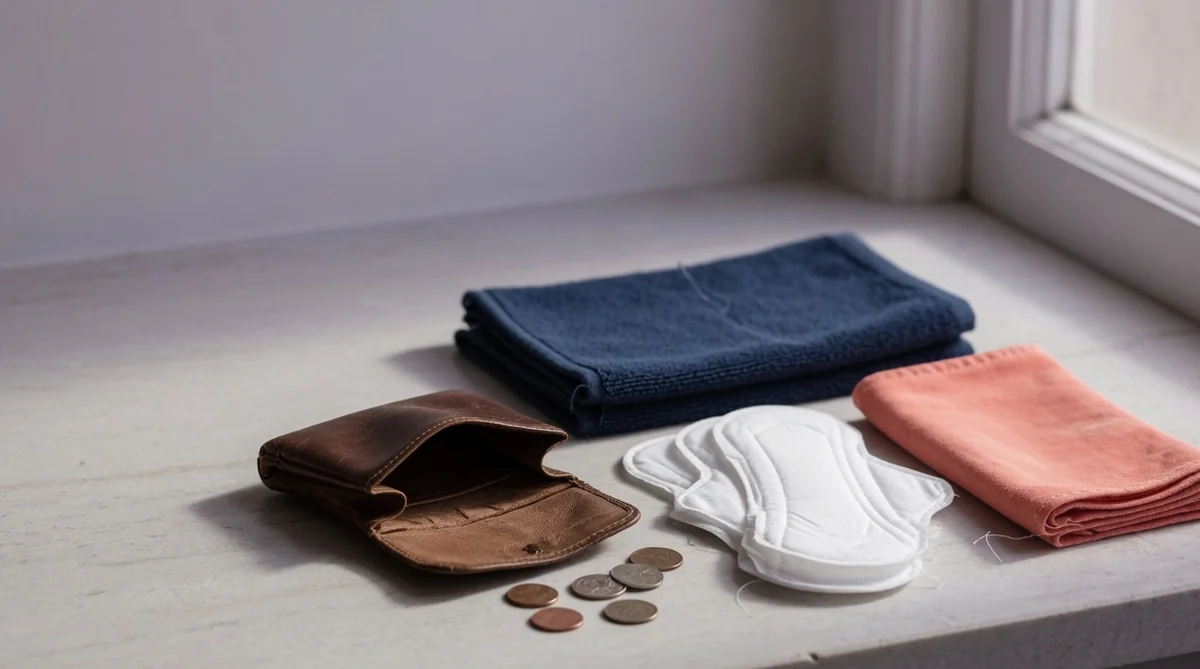
She was sixteen and had already missed third period twice that month. Not for cramps. For the practical problem of bleeding through the only pad she had and being too embarrassed to ask the school nurse again. Her mother worked nights. The box of products at home was empty by the second week of every cycle. When I saw her later for irregular bleeding that turned out to be a simple anovulatory pattern, the first thing she asked was not about hormones. It was whether the clinic had free pads she could take with her.
That is period poverty in a clinic hallway: not an abstract equity slogan, but a recurring gap between a basic monthly need and the money, stock, or bathroom dispenser required to meet it. Period poverty is inadequate access to menstrual products, hygiene facilities, and education because of cost or stigma. Menstrual equity is the policy response: affordability, free access in public settings, and the end of sales taxes that treat pads and tampons as luxuries.
This article gathers the numbers reporters and clinicians reach for when a state bill moves. How many teens and low-income women cannot afford products. How often school time is lost. What extended product use costs in health risk. How much products cost over a lifetime. How many states have repealed the tampon tax or required free products in schools.
Key takeaways
- In 2025, 24% of U.S. teens who menstruate still struggle to afford period products, according to the State of the Period survey commissioned by PERIOD. and Thinx; among lower-income teens the share rises to 34%.
- Nearly two-thirds (64%) of low-income women in a 2019 Obstetrics & Gynecology study in St. Louis could not afford needed menstrual supplies in the prior year; 21% faced that gap every month (Sebert Kuhlmann et al.).
- Among St. Louis high school students surveyed, 33.6% reported missing school because they lacked period products, per a 2021 Journal of School Nursing study.
- As of January 2026, 32 states have removed the sales tax on period products and 18 still tax them; 27 states plus Washington, D.C., have passed laws expanding free menstrual products in schools (PERIOD.).
- Forty-five percent of teens in 2025 reported wearing a period product longer than recommended because products were not accessible; the FDA advises changing tampons every 4 to 8 hours and never wearing one more than 8 hours.
24%
Teens struggling to afford products
State of the Period, 2025
64%
Low-income women unable to afford supplies (prior year)
Obstet Gynecol, 2019
32
States with no sales tax on period products
PERIOD., Jan 2026
Period poverty at a glance
- Teen affordability gap (2025)
- 24% of menstruating teens; 34% among lower-income teens (State of the Period)
- Low-income adult sample
- 64% could not afford products in the prior year; 46% chose between food and products (St. Louis, 2019)
- College students
- 14.2% past-year (not monthly); 10% every month (Cardoso et al., 2021)
- School absence (St. Louis HS)
- 33.6% missed school for lack of products
- Product insecurity trend
- 59% of U.S. adults who menstruate in 2021 vs. 53% in 2018 (J Women's Health)
- State policy (Jan 2026)
- 32 states tax-free; 27 states + D.C. with school free-product laws
How common is period poverty
There is no single federal prevalence survey for period poverty. National consumer polls, college samples, and community studies still converge: a large minority of people who menstruate cannot reliably buy pads, tampons, or cups when they need them.
The State of the Period series, commissioned by PERIOD. and Thinx, is the most cited national snapshot for adolescents. In 2025, 24% of U.S. teens ages 13 to 19 who menstruate reported struggling to afford period products, essentially unchanged from 23% in 2023. Among lower-income teens (household income under $50,000), 34% struggled to afford products or could not purchase them at all. Black teens were especially likely to say household economic pressure had affected product purchases (45%). Hispanic and lower-income teens reported higher rates of stretching products when stock ran short.
Among adults, the 2023 State of the Period survey found that roughly one-third (34%) struggled to afford products. A nationally representative Journal of Women's Health analysis published in 2024 compared 2018 and 2021 samples of adults ages 18 to 49 who had menstruated in the past year. Period product insecurity rose from 53% in 2018 to 59% in 2021 (Palovick et al.). Hispanic respondents were more likely to find products unaffordable in both years.
A 2023 Frontiers in Reproductive Health editorial by Sacca and colleagues cites an estimate that about 16.9 million menstruating women in the United States live in poverty. That is a poverty-population figure, not a direct count of people missing products, but it marks how large the cost-sensitive group is.
College students often sit between those poles. Cardoso and colleagues surveyed 471 college-attending women for BMC Women's Health in 2021: 14.2% had experienced period poverty in the past year, and an additional 10% experienced it every month. Monthly period poverty was linked with higher odds of moderate or severe depression on the PHQ-9 (adjusted odds ratio 2.34). That does not prove causation, but it is a clean association clinicians should know.
If you are tracking cycles while juggling cost, our period calculator and cycle length tool can help plan product needs around expected bleed days. Planning does not fix poverty. It can reduce the number of days someone is caught without a pad.
Students and school absenteeism
School is where period poverty becomes measurable as lost instructional time.
In the 2025 State of the Period survey, 33% of teens reported missing at least 15 minutes of class because they lacked access to period products, and 39% said limited access left them unable to do their best on schoolwork. Separately, 65% reported missing class time because of menstrual symptoms alone. Product access and pain are related but not identical problems. Free bathroom stock will not treat dysmenorrhea. It will stop the student who leaves campus to buy a pad and never returns for chemistry.
A carefully documented local sample comes from St. Louis. Sebert Kuhlmann and colleagues surveyed 119 high school students for the Journal of School Nursing: 64.4% reported period product insecurity, 33.6% reported missing school because they lacked products, and 66.9% had used at least one school resource to obtain them. Those figures are local, not national, but they cleanly tie product scarcity to absence rather than pain alone.
The 2023 State of the Period survey found 25% of teens unable to do schoolwork because of product access gaps, and 61% agreed that too many people miss school time for the same reason. By 2025, 39% said they rarely or never find products in school bathrooms, down from 53% in 2023. Free stock is improving unevenly. Affordability is not.
Students who already navigate broader gaps in women's healthcare access often face the same pattern at school: the nurse's office becomes a pharmacy of last resort, when there is a nurse at all.
Dr. Sarah Jenkins, OB/GYN
When a teenager tells me she "just stays home on heavy days," I ask two questions: Is it pain, or is it products? The answers require different interventions. Ibuprofen and a hormonal option for one. A funded bathroom dispenser, and a household that is not choosing between groceries and pads, for the other.
Low-income women and product insecurity
The study that still anchors adult clinical discussions is Sebert Kuhlmann's 2019 paper in Obstetrics & Gynecology. Researchers interviewed 183 low-income women through community organizations in St. Louis. Nearly two-thirds (64%) could not afford needed menstrual hygiene supplies during the previous year; 21% faced that shortfall every month; and 46% could not afford both food and menstrual products in the same year. Women described improvising with cloth, rags, tissues, toilet paper, paper towels from public restrooms, and even children's diapers.
That paper is not a national probability sample. It is a rigorous community study of the population most affected, published in a major obstetrics journal, and it remains the figure most often quoted when journalists need a primary-source percentage for low-income U.S. women.
Federal nutrition programs still do not treat menstrual products as covered essentials. SNAP and WIC do not pay for pads or tampons. Health savings and flexible spending accounts can cover menstrual products after a 2020 federal change, but only for people who have those accounts and spare pre-tax cash. For many patients below the poverty line, the choice is still between a box of pads and a gallon of milk.
Heavy bleeding multiplies how many products a person needs each cycle. Unintended pregnancy and method access also shape bleeding patterns; see our data on contraception access and unintended pregnancy. Women with heavy flow also face higher risk of iron deficiency anemia, which is why product scarcity sits next to measurable clinical disease rather than beside "hygiene" alone.
Health consequences of extended product use
When products are scarce, people stretch them. Clinicians should state the risks plainly without turning every missed pad into a horror story.
In the 2025 State of the Period survey, 45% of teens admitted wearing a period product longer than recommended because products were not accessible. Lower-income teens (53%) and Hispanic teens (52%) reported this more often. In the 2023 survey, 40% of teens and 52% of adults reported wearing products longer than recommended (that earlier poll did not attach the same access-reason wording). These are self-report figures, not hospital counts, but they map onto everyday clinical advice.
FDA consumer guidance is clear: change each tampon every 4 to 8 hours, never wear one more than 8 hours, use the lowest absorbency needed, and use tampons only during menstruation. Toxic shock syndrome (TSS) is rare compared with the early 1980s, but it remains an emergency. Watch for sudden high fever, vomiting, diarrhea, dizziness or fainting, and a sunburn-like rash. The FDA notes that reported tampon-associated TSS declined after product redesign, absorbency labeling, and education, not because prolonged wear became safe.
CDC historical analyses found continuous tampon use carried higher risk than alternating with other products, and higher absorbency raised risk further. Counseling still follows that evidence: lowest effective absorbency, time-limited wear, and pads or period underwear when overnight change is unrealistic. For someone stretching one tampon across a full school or work day because another is unaffordable, the risk talk is a cost talk.
Extended pad wear and makeshift materials also raise concerns about irritation and dermatitis, with uneven evidence for each pathway. The patient report is consistent: when products run out, people use what they can find. Clinics that stock free products and ask about access catch problems earlier than clinics that only ask about flow volume.
If bleeding changes suddenly, or a period is late and pregnancy is possible, start with evaluation. Our guide on why a period might be late and the late period calculator can help frame next steps while you arrange care.
Lifetime cost and the tampon tax
Menstruation is a multi-decade expense. A 2023 review in Current Epidemiology Reports (Ramaiyer et al.) states that an individual in the United States spends, on average, about $18,000 on menstrual products over a lifetime. Other estimates put pre-tax product spending nearer $6,000 across roughly 40 years, or about $13 or more per month; brand, absorbency, tax, pain medication, and laundry all move the total. Teens in the 2025 State of the Period survey reported average household spending near $40 per month. The direction is consistent: the cost is recurring, non-optional, and concentrated on people who menstruate.
Sales tax magnifies that cost where products remain taxable. As of January 2026, PERIOD. reports that 32 states have removed the sales tax on period products and 18 still tax them. Five states (Alaska, Delaware, Montana, New Hampshire, and Oregon) have no statewide sales tax. PERIOD. cites Period Law's estimate that roughly $130 million is still collected each year in sales tax on period products nationwide. That sum is small in a state budget and large in a household choosing between food and pads.
The "tampon tax" is ordinary sales tax applied because pads and tampons were never exempted the way many groceries or prescription drugs are. Repeals have moved state by state since the mid-2010s. Confirm a state's current status against a live tracker before publishing.
WHO's 2022 statement on menstrual health and rights framed access to products and facilities as a health and human rights issue, not merely a hygiene preference. ACOG has long treated the menstrual cycle as a vital sign in adolescents. That clinical stance sits awkwardly beside policies that still tax the tools required to manage menstruation in public.
Free products in schools and equity laws
Tax repeal lowers the price at checkout. Free-product mandates put supplies where people already are.
As of January 2026, PERIOD. reports that 27 states and Washington, D.C., have passed laws expanding free menstrual products in schools. Details vary: some statutes fund dispensers; others mandate products without money. Some cover only secondary grades; others reach elementary schools or public colleges. California's Menstrual Equity for All Act (AB 367) requires products in grades 6-12 restrooms. Oregon's Menstrual Dignity Act covers public school students more broadly. Illinois requires products for grades 4-12. A statute is not a stocked dispenser on a Tuesday in a rural district, which is why students still report empty machines in mandating states.
Federal proposals, including versions of the Menstrual Equity for All Act, have targeted schools and prisons as well as shelters and Medicaid coverage of supplies. No national free-product statute has replaced the state patchwork. Clinics and school nurses remain stopgaps.
For clinicians, the practical steps are concrete. Ask whether patients can afford products this month. Stock pads in exam rooms. Know your state's tax and school rules. Connect patients to pantries that include menstrual supplies. Period poverty is not solved in one visit, but it can stop being invisible in one.
Patients who stretch products sometimes present with irritation or recurrent genitourinary symptoms. Our overview of UTI patterns in women covers related prevention questions, even though UTIs are not caused by period poverty itself.
Frequently asked questions about period poverty
What percentage of U.S. teens cannot afford period products?
In the 2025 State of the Period survey by PERIOD. and Thinx, 24% of U.S. teens ages 13 to 19 who menstruate reported struggling to afford period products, nearly unchanged from 23% in 2023. Among lower-income teens, 34% struggled to afford products or could not buy them. These are national online survey estimates, not school administrative data.
How common is period poverty among low-income women?
In a 2019 Obstetrics & Gynecology study of 183 low-income women in St. Louis, 64% could not afford needed menstrual supplies in the previous year, 21% faced that gap monthly, and 46% could not afford both food and products. National adult product insecurity was reported at 59% in 2021 versus 53% in 2018 in a Journal of Women's Health analysis.
Does lack of menstrual products cause school absences?
Yes, in documented samples. In a St. Louis high school survey published in the Journal of School Nursing, 33.6% of students reported missing school because they lacked period products. Nationally, the 2025 State of the Period survey found 33% of teens missed at least 15 minutes of class due to product access gaps, and 39% felt unable to do their best schoolwork for the same reason.
How many states have repealed the tampon tax?
As of January 2026, PERIOD. reports that 32 states have removed the sales tax on period products and 18 still tax them. Alaska, Delaware, Montana, New Hampshire, and Oregon have no statewide sales tax. Because legislatures change the map frequently, confirm a specific state's status before publication.
How many states require free period products in schools?
As of January 2026, 27 states and Washington, D.C., have passed laws to expand free menstrual products in schools, according to PERIOD. Laws differ on funding, grade levels, restroom placement, and whether colleges are included. Passage does not guarantee consistent stocking in every building.
What are the health risks of wearing a tampon too long?
The FDA advises changing tampons every 4 to 8 hours and never wearing one more than 8 hours. Prolonged wear is linked to higher risk of menstrual toxic shock syndrome, a rare but serious bacterial toxin illness. Use the lowest absorbency needed, and seek urgent care for sudden high fever, rash, vomiting, diarrhea, or dizziness during or just after a period. In 2025, 45% of teens reported wearing products longer than recommended when products were hard to access.
Tags:Period PovertyMenstrual EquityReproductive HealthWomen's Health StatisticsMenstrual ProductsTampon Tax
Sources & Citations
- PERIOD. & Thinx. (2025). State of the Period 2025.[Source]
- PERIOD. & Thinx. (2023). State of the Period 2023.[Source]
- Sebert Kuhlmann A, Peters Bergquist E, Danjoint D, Wall LL. (2019). Unmet menstrual hygiene needs among low-income women. Obstetrics & Gynecology, 133(2), 238–244.[Source]
- Sebert Kuhlmann A, Teni MT, Key R, Billingsley C. (2021/2024). Period product insecurity, school absenteeism, and use of school resources to obtain period products among high school students in St. Louis, Missouri. Journal of School Nursing, 40(3), 329–335.[Source]
- Cardoso LF, Scolese AM, Hamidaddin A, Gupta J. (2021). Period poverty and mental health implications among college-aged women in the United States. BMC Women's Health, 21(1), 14.[Source]
- Palovick KA, Hunter E, Teni MT, Sebert Kuhlmann A. (2024). Period product insecurity is increasing in the United States: trends from 2018 to 2021. Journal of Women's Health, 33(1), 20–27.[Source]
- Sacca L, Markham CM, Gupta J, Peskin M. (2023). Editorial: Period poverty. Frontiers in Reproductive Health, 5, 1140981.[Source]
- PERIOD. (2026). Advocacy: period products in schools and the tampon tax.[Source]
- Ramaiyer M, Lulseged B, Michel R, Ali F, Liang J, Borahay MA. (2023). Menstruation in the USA. Current Epidemiology Reports, 10(4), 186–195.[Source]
- FDA. (2025). The facts on tampons—and how to use them safely.[Source]
- CDC. (1990). Historical perspectives: reduced incidence of menstrual toxic-shock syndrome — United States, 1980–1990. MMWR.[Source]
- ACOG. (2015, reaffirmed). Committee Opinion No. 651: Menstruation in girls and adolescents—using the menstrual cycle as a vital sign.[Source]
- WHO. (2022). WHO statement on menstrual health and rights.[Source]
Cite this page
Journalists, researchers and educators are welcome to quote these figures. Please credit Women's Health Association and link to this page so readers can reach the underlying sources.
Women's Health Association. (2026, August 10). Period poverty statistics: who cannot afford menstrual products and what the law is changing. Retrieved from https://www.womenshealthassoc.com/insights/period-poverty-menstrual-equity-statistics
Published 2026, August 10

!
Medical Disclaimer
This content is for informational purposes only and is not a substitute for professional medical advice, diagnosis, or treatment. Always seek the advice of your physician or other qualified health provider with any questions you may have regarding a medical condition.
Keep Reading
View all articles
Reproductive Health 14 min read
Abortion access and travel distance statistics: how far U.S. patients travel after Dobbs
Mean travel time to the nearest abortion facility rose from 27.8 to 100.4 minutes after Dobbs. Here is the confirmed data on state bans, out-of-state travel volume, clinic closures, and the share of care delivered by telehealth.
Reproductive Health 15 min read
Contraception access statistics: unintended pregnancy and the gaps that remain
41.6% of U.S. pregnancies were unintended in 2019, and more than 19 million women who need publicly funded contraception live in contraceptive deserts. Here is the latest data on method use, cost, OTC pills, failure rates, and Title X capacity.
Reproductive Health 13 min read
Menstrual cycle app data privacy statistics: who tracks, what gets shared, and how often predictions miss
Nearly 1 in 3 U.S. women track fertility or periods digitally, yet audits find most popular women's mHealth apps share data with third parties. Primary figures on usage, privacy audits, prediction accuracy, FTC actions, and user trust.
Evidence in your inbox.
Join 250,000+ women receiving our weekly breakdown of new research, policy changes, and health tools.