Loading...
Cardiovascular13 min readUpdated
Heart disease in women: statistics, risk factors, and why the gender gap persists
Cardiovascular disease killed 446,912 U.S. women in 2022. Nearly 45% of women over 20 have some form of CVD, yet most still think of heart disease as a men's problem. Here is what the latest data tells us.

Written By
Dr. Emily Chen
Chief Medical Officer

Medically Reviewed By
Dr. Sarah Jenkins
Board Certified OB/GYN
Share
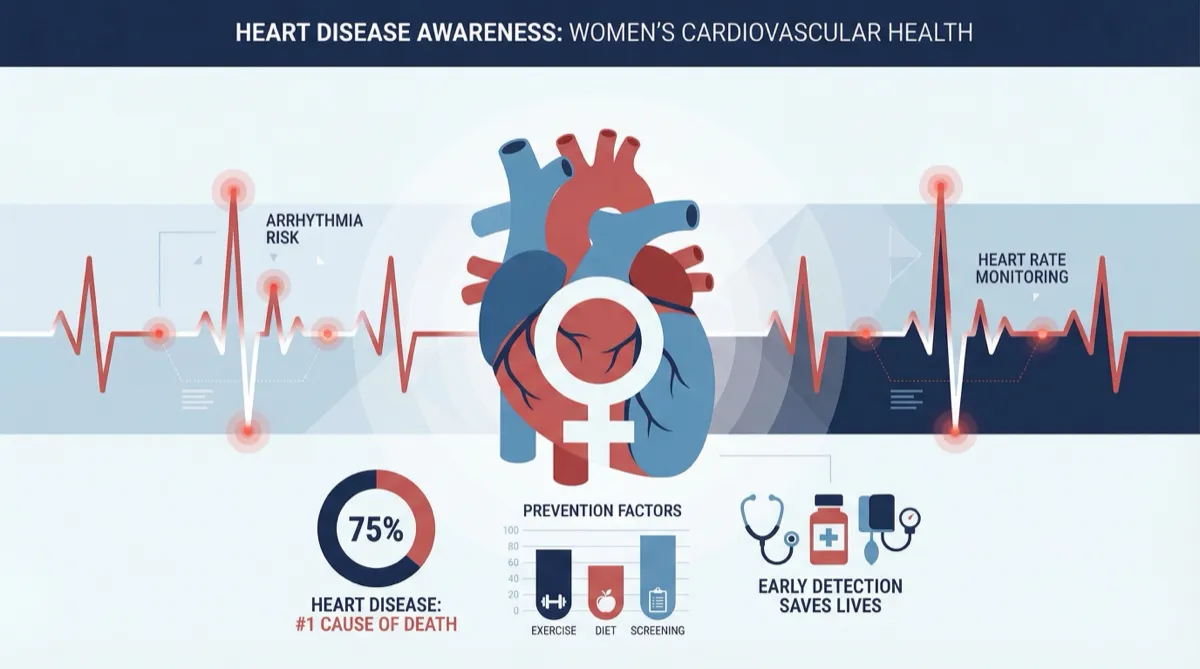
When I ask women what they think the leading cause of death for women is, most say breast cancer. Some say ovarian cancer. A few say car accidents. Almost nobody says heart disease. And yet cardiovascular disease killed 446,912 women in the United States in 2022. That is roughly one woman every 71 seconds. More than all cancers combined.
Heart disease has been the leading killer of American women for decades, but the perception gap has barely budged. Women are underrepresented in cardiovascular clinical trials, underdiagnosed in emergency rooms, and undertreated after a cardiac event. The data on this is extensive and, frankly, damning.
This article covers the most recent cardiovascular statistics for women, drawing primarily from the American Heart Association's 2025 Statistical Update, along with CDC data and published research on sex-specific risk factors and disparities.
Key takeaways
- Cardiovascular disease caused 446,912 deaths among U.S. women in 2022, making it the leading cause of death for women, per the AHA's 2025 Statistical Update.
- About 44.8% of U.S. women aged 20 and older have some form of cardiovascular disease, including hypertension, coronary heart disease, heart failure, or stroke.
- Black women have the highest CVD prevalence at approximately 59%, compared to 43% in white women and 42% in Hispanic women.
- Women who have a heart attack are more likely than men to be misdiagnosed initially, wait longer for treatment, and receive less aggressive intervention.
- Pregnancy-related complications (preeclampsia, gestational diabetes, and preterm delivery) are now recognized as independent risk factors for future cardiovascular disease.
446,912
U.S. women died from cardiovascular disease in 2022. That is more than all cancers combined.
American Heart Association, Heart Disease and Stroke Statistics, 2025 Update
446,912
U.S. women killed by CVD in 2022
AHA, 2025
44.8%
Women 20+ with some form of CVD
AHA, 2025
59%
CVD prevalence in Black women
AHA, 2025
38%
Women in CV clinical trials
Mehta et al., 2016
Heart disease in women at a glance
- CVD deaths, women, 2022
- 446,912 (AHA 2025)
- Women 20+ with any CVD
- 44.8%
- Black women CVD prevalence
- ~59%
- White women CVD prevalence
- ~43%
- Hypertension, women 20+
- ~42%
- Women in CV clinical trials
- ~38%
The mortality numbers
Cardiovascular disease killed 446,912 U.S. women in 2022, according to the AHA's 2025 Heart Disease and Stroke Statistical Update. Coronary heart disease accounted for the largest share, followed by stroke, heart failure, and other forms of cardiovascular illness.
To put that in perspective: breast cancer kills approximately 42,000 American women per year. Lung cancer kills about 59,000. CVD kills nearly 447,000. It is not close.
The age-adjusted CVD death rate for women has been declining since the 1980s, largely due to improvements in blood pressure management, cholesterol treatment, smoking cessation, and acute cardiac care. Between 2012 and 2022, the female CVD death rate dropped by about 12%. But progress has stalled since the COVID-19 pandemic. In 2020 and 2021, CVD mortality rates among women actually increased for the first time in decades, driven by pandemic-related disruptions in preventive care and an increase in stress-related cardiovascular events.
One number that gets overlooked: sudden cardiac death. Approximately 230,000 women experience cardiac arrest outside of a hospital each year. Survival is dismal (about 10%) in part because bystanders are less likely to perform CPR on women than on men. A 2018 study in Circulation found that women who had cardiac arrest in public were 27% less likely to receive bystander CPR than men.
Prevalence by age and race
The AHA's 2025 update reports that 44.8% of U.S. women aged 20 and older have some form of cardiovascular disease. That includes hypertension (which accounts for the majority of cases), coronary heart disease, heart failure, and stroke.
Prevalence increases sharply with age. Among women aged 20 to 39, CVD prevalence is around 14%, largely driven by hypertension. By age 60 to 79, it exceeds 75%.
The racial disparities are stark.
| Race/ethnicity | CVD prevalence (women 20+) | Heart disease death rate per 100,000 |
|---|---|---|
| Non-Hispanic Black | ~59% | 168.1 |
| Non-Hispanic white | ~43% | 126.3 |
| Hispanic/Latina | ~42% | 88.4 |
| Asian American | ~35% | 63.2 |
Source: AHA 2025 Statistical Update; CDC WONDER mortality data
Black women carry the highest burden by a wide margin. Their age-adjusted heart disease death rate is 33% higher than that of white women. The drivers are not primarily genetic. They are structural. Black women have higher rates of hypertension (56% versus 41% in white women), higher rates of diabetes, less access to cardiologists, and more exposure to chronic stress and discrimination, all of which have measurable cardiovascular effects.
Why heart disease presents differently in women
Heart disease does not look the same in women as it does in men, and that difference has clinical consequences.
The classic heart attack presentation (crushing chest pain radiating to the left arm) was defined based on studies conducted predominantly in men. Women having a heart attack are more likely to present with shortness of breath, nausea, fatigue, jaw pain, or upper back discomfort. Some women describe it as a general sense of feeling unwell. A 2016 AHA scientific statement by Mehta et al. noted that women with acute myocardial infarction are more likely to report atypical symptoms and less likely to describe the experience as "chest pain."
| Heart attack symptom | Women | Men |
|---|---|---|
| Crushing chest pain | Less common | Most common presentation |
| Shortness of breath | Frequently primary symptom | Often secondary |
| Nausea / vomiting | Common | Less common |
| Jaw or upper back pain | Common | Uncommon |
| Fatigue / malaise | May be only symptom | Rarely sole symptom |
| Arm pain (left) | Less typical | Classic presentation |
Source: Mehta et al., AHA Scientific Statement, Circulation, 2016
Beyond symptom presentation, the underlying pathology differs. Men tend to develop obstructive coronary artery disease: large blockages in major arteries visible on angiography. Women more frequently develop microvascular disease, where the smaller vessels of the heart are damaged or dysfunctional but the large arteries look normal on imaging. This means a woman can have a heart attack, go to the ER, get a cardiac catheterization that shows "clean" arteries, and be sent home with a reassurance that her heart is fine. It is not fine. The 2016 review by Garcia et al. in Circulation Research estimated that 50% to 70% of women with ischemic symptoms who undergo angiography have non-obstructive coronary disease.
Spontaneous coronary artery dissection (SCAD) (a tear in a coronary artery wall) is another condition that disproportionately affects women. SCAD accounts for up to 35% of heart attacks in women under 50. It was historically considered rare but is now recognized as significantly underdiagnosed.
Risk factors specific to women
Many traditional risk factors (high blood pressure, high cholesterol, smoking, diabetes, obesity) apply to both sexes. But women have additional risk factors that men do not, and many of them are tied to reproductive history.
A 2021 AHA scientific statement by Parikh et al. identified several pregnancy-related conditions as independent predictors of future cardiovascular disease:
- Preeclampsia doubles a woman's lifetime risk of coronary heart disease and stroke. Women who develop preeclampsia during pregnancy are 4 times more likely to develop heart failure within 10 years.
- Gestational diabetes increases the risk of type 2 diabetes sevenfold and the risk of cardiovascular disease by 40% to 70% over the next two decades. For more on gestational diabetes, see our statistics and risk guide.
- Preterm delivery (before 37 weeks) is associated with a 40% higher risk of cardiovascular disease later in life, independent of other risk factors.
- Recurrent pregnancy loss and placental abruption are also associated with elevated cardiovascular risk.
Early menopause (before age 40) is another female-specific risk factor. The loss of estrogen's cardioprotective effects at an earlier age increases coronary heart disease risk by 50%. Women who undergo surgical menopause (bilateral oophorectomy) before age 45 without estrogen replacement have a similarly elevated risk.
Autoimmune diseases, which are far more common in women (lupus, rheumatoid arthritis, psoriasis) also increase cardiovascular risk. Women with lupus have a 2- to 10-fold increase in coronary heart disease risk compared to women without the disease.
If you are approaching menopause or experiencing hormonal changes, our perimenopause symptom guide covers what to expect and when to talk to your doctor about cardiovascular screening.
The diagnosis gap
Women are more likely than men to be misdiagnosed when they arrive at the emergency department with a heart attack.
A 2020 study by Gulati et al. published in Heart (a BMJ journal) analyzed data on sex-specific misdiagnosis of acute myocardial infarction. They found that women who were initially misdiagnosed had significantly worse outcomes, including higher mortality at 30 days. Initial misdiagnosis was more common in women presenting with non-ST-elevation myocardial infarction (NSTEMI), the type of heart attack that is more prevalent among women.
Part of the problem is speed. Multiple studies have documented that women wait longer from symptom onset to first medical contact. They also wait longer in the emergency department before receiving an ECG. A large European registry found that women presenting with ST-elevation myocardial infarction (STEMI) received reperfusion therapy an average of 18 minutes later than men. Eighteen minutes. In cardiology, time is muscle. Those minutes matter.
Dr. Emily Chen, Chief Medical Officer
The cultural image of a heart attack is a man clutching his chest. That image is killing women. When a woman shows up to the ER with jaw pain and nausea, the first thought is not always "cardiac." It should be.
Women themselves contribute to the delay. Because the cultural image of a heart attack is a man clutching his chest, many women do not recognize their own symptoms as cardiac. They attribute them to indigestion, anxiety, or fatigue. By the time they call 911, more myocardial tissue has been lost.
Treatment disparities
Even after diagnosis, treatment is not equal.
Women who have a heart attack are less likely than men to receive guideline-recommended therapies at discharge, such as aspirin or beta-blockers. They are also less likely to get statins and dual antiplatelet therapy. Referral to cardiac rehabilitation is less common for women. When they are referred, they are less likely to attend. Caregiving duties and transportation get in the way, and many programs were built around the schedules of male patients.
The 2016 Mehta AHA scientific statement reported that women with acute MI have higher in-hospital mortality than men, even after adjusting for age and comorbidities. Younger women face a particularly severe penalty: women under 55 who have a heart attack have roughly twice the in-hospital mortality rate of men the same age.
Representation in clinical trials remains a persistent issue. Women make up only about 38% of participants in cardiovascular clinical trials, despite representing more than half of CVD patients over age 65. Drug dosing, device sizing, and treatment algorithms developed in predominantly male populations may not be optimal for women.
What the 2025 AHA data tells us
The AHA's 2025 Heart Disease and Stroke Statistical Update, published in Circulation in January 2025, provides the most current national data. A few numbers from the report that stood out to me:
Hypertension prevalence among U.S. women aged 20 and older is approximately 42%. It is the single largest driver of CVD prevalence in women and the most modifiable. Among Black women, hypertension prevalence is 56%, the highest of any demographic group in the country.
Heart failure hospitalization rates among women increased by 14% between 2015 and 2022. Heart failure with preserved ejection fraction (HFpEF) (a form of heart failure where the heart pumps normally but does not relax properly) disproportionately affects women and has fewer effective treatments than heart failure with reduced ejection fraction.
Stroke death rates declined overall between 2012 and 2019 but increased during 2020 and 2021. Women account for about 55% of all stroke deaths because they live longer and stroke risk increases with age. At every age above 85, women have higher stroke mortality than men.
The AHA report also noted that cardiovascular health among young adults (20 to 39) is declining. Obesity and metabolic syndrome rates are rising; so is diabetes. That trend is concerning because it suggests the improvements in CVD mortality we saw over the past two decades may reverse.
Prevention that actually works
The most effective interventions for reducing cardiovascular risk in women are unglamorous. They work, and most of them are underutilized.
- Blood pressure control. Hypertension is the number one modifiable risk factor for women. The AHA recommends a target below 130/80 mmHg. Medication should not be a last resort; for many women, it is necessary alongside lifestyle changes.
- Statin therapy. For women with elevated cardiovascular risk (10-year ASCVD risk ≥7.5%), statins reduce major cardiac events by 20% to 30%. Women are less likely than men to be prescribed statins, even when they meet guideline criteria.
- Physical activity. 150 minutes per week of moderate aerobic exercise reduces CVD risk by approximately 30% to 40%. A 2024 study in JAMA found that women achieved the same cardiovascular mortality reduction as men with roughly 60% of the exercise volume. Current guidelines may therefore underestimate the benefit of exercise for women.
- Smoking cessation. Women who smoke have a 25% higher relative risk of coronary heart disease compared to male smokers, per a meta-analysis in The Lancet. Quitting reverses much of that excess risk within 5 years.
- Pregnancy history review. Ask your doctor to include your pregnancy history in your cardiovascular risk assessment. Preeclampsia, gestational diabetes, and preterm delivery should be treated as red flags for long-term heart health.
If you have a history of pregnancy complications or are tracking hormonal changes, our health resources page has additional tools and information.
Frequently asked questions about heart disease in women
Is heart disease the leading cause of death for women?
Yes. Cardiovascular disease killed 446,912 U.S. women in 2022, making it the number one cause of death for women, according to the AHA's 2025 Statistical Update. Heart disease kills more women than all cancers combined. Breast cancer, by comparison, causes approximately 42,000 female deaths per year.
What percentage of women have heart disease?
About 44.8% of U.S. women aged 20 and older have some form of cardiovascular disease, including hypertension, coronary heart disease, heart failure, and stroke, per the AHA's 2025 data. Prevalence is highest among Black women at approximately 59%, compared to 43% in white women.
Do women have different heart attack symptoms than men?
Yes. Women are more likely to experience shortness of breath, nausea, fatigue, jaw pain, and upper back discomfort during a heart attack, rather than the classic crushing chest pain. A 2016 AHA scientific statement noted that women with acute myocardial infarction more frequently report atypical symptoms, which contributes to delayed diagnosis and higher misdiagnosis rates.
Does pregnancy affect heart disease risk?
Yes. Preeclampsia doubles lifetime coronary heart disease and stroke risk. Gestational diabetes increases cardiovascular risk by 40% to 70% over the next two decades. Preterm delivery raises cardiovascular disease risk by 40%. A 2021 AHA scientific statement by Parikh et al. identified these as independent cardiovascular risk factors that should be assessed during routine care.
Why is heart disease worse for Black women?
Black women have a CVD prevalence of approximately 59% and a heart disease death rate 33% higher than white women. The drivers are primarily structural: higher rates of hypertension (56% versus 41%), higher diabetes prevalence, less access to cardiologists, chronic stress from discrimination, and systemic healthcare inequities. Genetics is not the main explanation.
Are women underrepresented in heart disease research?
Yes. Women make up only about 38% of participants in cardiovascular clinical trials despite comprising more than half of CVD patients over age 65. Drug dosing, device sizing, and treatment algorithms developed in predominantly male studies may not be optimal for women, contributing to worse outcomes after cardiac events.
Tags:Heart DiseaseCardiovascular HealthWomen's Health StatisticsRisk FactorsHealth Disparities
Sources & Citations
- American Heart Association. (2025). Heart disease and stroke statistics — 2025 update. Circulation.[Source]
- Mehta LS, et al. (2016). Acute myocardial infarction in women: a scientific statement from the American Heart Association. Circulation, 133(9), 916–947.[Source]
- CDC. (2024). Women and heart disease.[Source]
- Garcia M, et al. (2016). Cardiovascular disease in women: clinical perspectives. Circulation Research, 118(8), 1273–1293.[Source]
- Gulati M, et al. (2020). Adverse cardiovascular outcomes in women during sex-specific acute myocardial infarction misdiagnosis. Heart, 106(7), 539–546.[Source]
- Parikh NI, et al. (2021). Adverse pregnancy outcomes and cardiovascular disease risk: unique opportunities for cardiovascular disease prevention in women. Circulation, 143(18), e902–e916.[Source]
Cite this page
Journalists, researchers and educators are welcome to quote these figures. Please credit Women's Health Association and link to this page so readers can reach the underlying sources.
Women's Health Association. (2026, March 1). Heart disease in women: statistics, risk factors, and why the gender gap persists. Retrieved from https://www.womenshealthassoc.com/insights/heart-disease-women-statistics-risk-factors
Published 2026, March 1

!
Medical Disclaimer
This content is for informational purposes only and is not a substitute for professional medical advice, diagnosis, or treatment. Always seek the advice of your physician or other qualified health provider with any questions you may have regarding a medical condition.
Keep Reading
View all articles
Reproductive Health 14 min read
Abortion access and travel distance statistics: how far U.S. patients travel after Dobbs
Mean travel time to the nearest abortion facility rose from 27.8 to 100.4 minutes after Dobbs. Here is the confirmed data on state bans, out-of-state travel volume, clinic closures, and the share of care delivered by telehealth.

Mental Health 14 min read
ADHD in women and girls statistics: the late-diagnosis gap in plain numbers
Girls are diagnosed with ADHD at roughly half the rate of boys, yet more than half of U.S. adults with ADHD were first diagnosed at 18 or older. Here is the CDC, NCHS, and peer-reviewed data on sex gaps, adult diagnosis, age at identification, presentation differences, stimulant shortages, and comorbidity.

Chronic Conditions 12 min read
Alzheimer's dementia statistics in women: why two-thirds of patients are female
Almost two-thirds of Americans with Alzheimer's are women. Lifetime risk at 45 is about 1 in 5 for women versus 1 in 10 for men. Here is what the data says about prevalence, caregiving, APOE4, diagnosis delays, and cost of care.
Evidence in your inbox.
Join 250,000+ women receiving our weekly breakdown of new research, policy changes, and health tools.