Loading...
Pregnancy & Maternal13 min readUpdated
Gestational diabetes statistics: prevalence, risks, and what the data says about long-term outcomes
Gestational diabetes affects 2% to 10% of U.S. pregnancies, and about 50% of women who develop it go on to get type 2 diabetes within 10 years. Here is what the latest data tells us about who is affected and why rates keep rising.

Written By
Dr. Elena Rostova
Reproductive Endocrinologist

Medically Reviewed By
Maya Patel, RD
Clinical Dietitian
Share
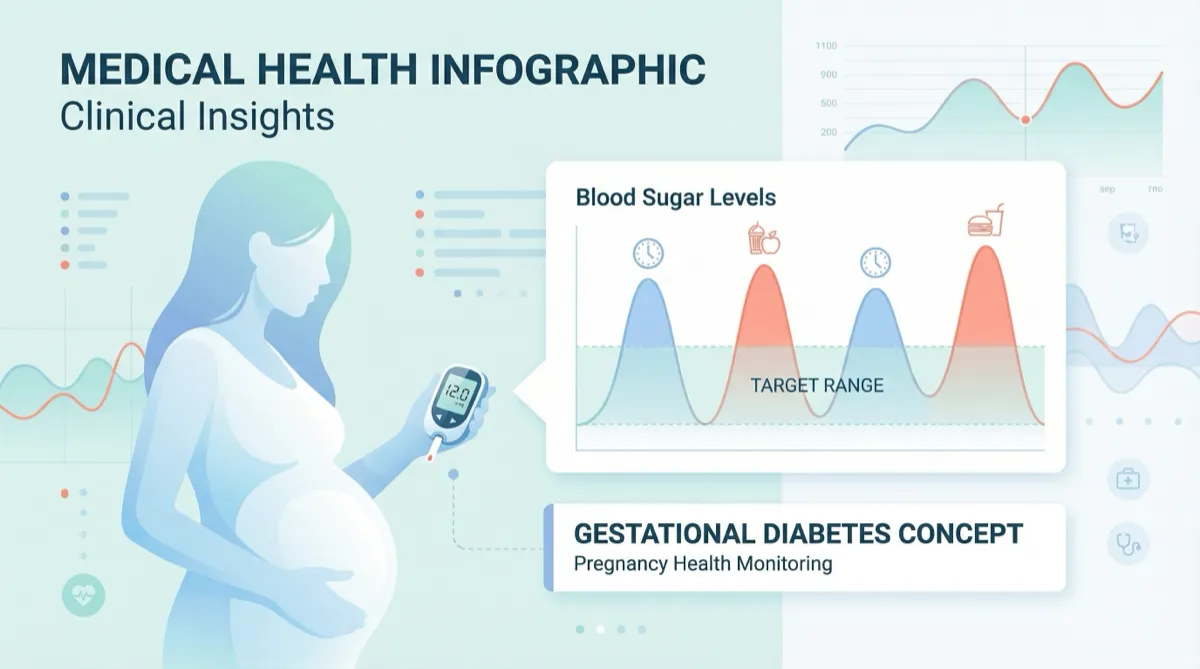
The glucose tolerance test at 24 weeks is a ritual of pregnancy that most women dread for its sugary orange drink and the hour of waiting. For most, it comes back normal and they move on. For the woman who gets the call that her numbers are high, the next several months change. She is now managing a condition that affects her pregnancy, her delivery, and (though she may not realize it yet) her health for decades afterward.
Gestational diabetes mellitus (GDM) is diabetes that develops during pregnancy in a woman who did not have diabetes before. It is driven by the hormonal changes of pregnancy, which increase insulin resistance in a way that some women's bodies cannot compensate for. The CDC estimates that GDM affects 2% to 10% of pregnancies in the United States annually. That range is broad because prevalence varies by race and age, and by which diagnostic criteria are used. By most recent estimates, the actual rate is closer to 8% and climbing.
This article breaks down the latest data on who gets gestational diabetes, why rates are rising, what happens during and after pregnancy, and what the racial disparities in this condition look like.
Key takeaways
- Gestational diabetes affects 2% to 10% of U.S. pregnancies, with the most recent data suggesting a prevalence of approximately 7.8%, per the CDC. The rate has roughly doubled since 2000.
- A 2021 JAMA study analyzing 12.6 million live births found GDM prevalence increased by 30% between 2011 and 2019, with the sharpest rises among non-Hispanic Asian and Hispanic women.
- About 50% of women with gestational diabetes develop type 2 diabetes within 5 to 10 years after delivery, according to a 2020 BMJ systematic review and meta-analysis.
- Women with a history of GDM have approximately twice the risk of cardiovascular disease later in life, per a 2019 meta-analysis in Diabetologia.
- The landmark HAPO study (NEJM, 2008) demonstrated a continuous relationship between maternal glucose levels and adverse pregnancy outcomes, with no clear threshold below which risk disappeared.
50%
of women with gestational diabetes develop type 2 diabetes within 5 to 10 years after delivery.
Vounzoulaki et al., BMJ, 2020: systematic review and meta-analysis
2-10%
Of U.S. pregnancies affected
CDC, 2024
50%
Develop type 2 diabetes within 10 years
BMJ, 2020
+30%
Rise in GDM prevalence, 2011-2019
JAMA, 2021
How common is gestational diabetes
Gestational diabetes at a glance
- Prevalence
- 2-10% of U.S. pregnancies; ~7.8% by recent estimates (CDC)
- Trend
- 30% increase in prevalence from 2011 to 2019 (JAMA)
- Highest-risk group
- Non-Hispanic Asian women (11.1% prevalence)
- Type 2 diabetes risk
- ~50% develop type 2 within 5-10 years post-delivery (BMJ)
- Cardiovascular risk
- 2× higher risk of heart disease (Diabetologia, 2019)
- Screening window
- 24-28 weeks gestation (ACOG); earlier if high-risk
The CDC's current estimate is that gestational diabetes affects 2% to 10% of pregnancies in the United States each year. That wide range reflects differences in study populations and diagnostic criteria. Using the more sensitive International Association of Diabetes and Pregnancy Study Groups (IADPSG) criteria, prevalence is closer to 15% to 18% in some populations. Using the older Carpenter-Coustan criteria that ACOG endorses, it is roughly 6% to 9%.
With approximately 3.6 million live births per year in the U.S., even the conservative 6% estimate means more than 216,000 women develop gestational diabetes annually. At the higher end, the number exceeds 360,000.
A 2021 study by Shah et al. published in JAMA, which analyzed 12.6 million live births from 2011 to 2019 in the National Center for Health Statistics dataset, found that the overall GDM prevalence increased from 4.7% in 2011 to 6.3% in 2019. That is a 30% relative increase over less than a decade. Among first live births, the rate was even higher.
Globally, the International Diabetes Federation estimates that approximately 16.7% of live births worldwide are affected by some form of hyperglycemia in pregnancy, with GDM accounting for the vast majority. That translates to roughly 21 million affected births per year.
Why prevalence keeps rising
The upward trend in gestational diabetes is not subtle. Multiple factors are contributing, and disentangling their individual effects is difficult.
Rising maternal age. Women in the United States are having children later. The average age at first birth was 27.3 in 2022, up from 24.9 in 2000. GDM risk increases with age: women over 35 have roughly 2 to 3 times the risk compared to women under 25. As the childbearing population ages, GDM prevalence rises mechanically.
Increasing rates of overweight and obesity. Pre-pregnancy BMI is one of the strongest predictors of gestational diabetes. The CDC reports that approximately 29% of women of reproductive age in the U.S. are obese (BMI ≥30). Obesity roughly triples the risk of GDM. The rising obesity rate among young women is directly fueling the GDM increase.
Changes in racial and ethnic composition. GDM prevalence varies substantially by race and ethnicity, and population shifts contribute to aggregate trends. This is not a commentary on biology. It reflects genetics, diet, socioeconomic status, and healthcare access working together.
Broader diagnostic criteria. Some of the increase reflects changes in how GDM is diagnosed. The IADPSG criteria, adopted by some institutions following the HAPO study results, use lower glucose thresholds and therefore identify more women. Whether this reclassification improves outcomes or leads to overdiagnosis is an active area of debate.
If you are planning a pregnancy and want to understand your fertile window and cycle patterns, our ovulation calculator and cycle length calculator can help. But metabolic preparation (including weight management and glucose screening) is equally important in the preconception period.
Racial and ethnic disparities
Gestational diabetes does not affect all women equally. The 2021 JAMA study by Shah et al. documented pronounced disparities in GDM prevalence by race and ethnicity among U.S. women:
| Race / ethnicity | GDM prevalence (2019) | Change from 2011 |
|---|---|---|
| Non-Hispanic Asian | 11.1% | +44% |
| American Indian / Alaska Native | 7.2% | +28% |
| Hispanic / Latina | 6.6% | +29% |
| Non-Hispanic White | 5.3% | +25% |
| Non-Hispanic Black | 5.1% | +24% |
Source: Shah et al., JAMA, 2021: analysis of 12.6 million live births, National Center for Health Statistics, 2011-2019.
Non-Hispanic Asian women have the highest GDM prevalence by a substantial margin. Within that group, rates vary further: South Asian and Filipino women have among the highest rates of any subpopulation studied, often exceeding 15%. This elevated risk is partly attributed to lower thresholds for insulin resistance at lower BMI levels in Asian populations, a pattern sometimes called the "metabolically obese, normal weight" phenotype.
American Indian and Alaska Native women also face disproportionate risk. Baseline type 2 diabetes rates are high in these communities. Limited prenatal care access and dietary factors tied to food insecurity and food desert geography add to the burden.
The disparities are compounded by differences in screening and treatment. A 2020 analysis found that Black women with GDM were less likely to receive postpartum glucose testing (the test that catches progression to type 2 diabetes) than white women, even when controlling for insurance status and healthcare access. That gap has downstream consequences that accumulate for years.
Risks during pregnancy
The HAPO study (Hyperglycemia and Adverse Pregnancy Outcomes), published in the New England Journal of Medicine in 2008, was a landmark investigation that followed 25,505 pregnant women across 15 centers in nine countries. Its central finding was that the relationship between maternal glucose levels and adverse outcomes was continuous. There was no clear threshold below which risk vanished.
Higher maternal glucose levels were associated with increased rates of:
- Macrosomia (birth weight above the 90th percentile): 25% of GDM pregnancies result in a large-for-gestational-age infant, compared to roughly 10% in non-GDM pregnancies
- Cesarean delivery: women with GDM have a c-section rate approximately 25% to 35% higher than women without GDM
- Neonatal hypoglycemia: the baby's pancreas, accustomed to high glucose from the mother, overproduces insulin after birth, causing blood sugar drops in the first hours of life
- Preeclampsia: GDM increases preeclampsia risk by approximately 40% to 60%
- Shoulder dystocia: a serious delivery complication where the baby's shoulders become stuck, more common when the baby is large
Stillbirth risk is also modestly elevated in poorly controlled GDM, though modern management has substantially reduced this risk. The data on this is mixed. Well-managed GDM does not appear to significantly increase stillbirth rates, but undiagnosed or undertreated cases carry meaningful excess risk.
If you are pregnant and tracking your due date, our IVF date calculator can help with timeline planning. For women with GDM, delivery timing (typically between 39 and 40 weeks for well-controlled cases, earlier for insulin-dependent cases) is an important discussion with your OB.
The type 2 diabetes pipeline
This is the statistic that stays with me: approximately 50% of women who have gestational diabetes will develop type 2 diabetes within 5 to 10 years after delivery.
A 2020 systematic review and meta-analysis by Vounzoulaki et al. published in the BMJ analyzed 20 studies involving more than 1 million women. The pooled relative risk of type 2 diabetes in women with a history of GDM was 9.51 compared to women without GDM. In absolute terms, about 16% to 20% developed type 2 diabetes within the first 5 years, and roughly 50% did so within 10 years.
That 10-fold relative risk makes GDM one of the strongest known predictors of future type 2 diabetes. Stronger than family history alone. Stronger than obesity alone.
The mechanism is straightforward. Pregnancy stress-tests the pancreas. Women who develop GDM have beta cells that could not produce enough insulin to overcome pregnancy-driven insulin resistance. After delivery, glucose levels typically normalize, but the underlying beta cell dysfunction persists. As the woman ages and insulin resistance increases naturally, the deficit reveals itself again, this time as permanent type 2 diabetes.
The tragedy is that postpartum glucose screening (which can catch prediabetes or early type 2 diabetes) is chronically underperformed. ACOG recommends that all women with GDM receive a 75-gram oral glucose tolerance test at 4 to 12 weeks postpartum. Studies consistently show that only 20% to 50% of eligible women complete this test. Some women are not told about it. Some are, but do not return for the appointment. The healthcare system loses them in the transition from obstetric care to primary care, and a window for early intervention closes.
| Outcome | Measure in women with prior GDM |
|---|---|
| Type 2 diabetes within 5 years | 16% to 20% |
| Type 2 diabetes within 5 to 10 years | ~50% |
| Relative risk of type 2 diabetes vs. women without GDM | 9.51× |
| Cardiovascular events (coronary disease, stroke, heart failure) | ~2× risk |
| Postpartum 75-g OGTT completed at 4-12 weeks (ACOG recommended) | 20% to 50% of eligible women |
Source: Vounzoulaki et al., BMJ, 2020 (type 2 diabetes follow-up) and Kramer et al., Diabetologia, 2019 (cardiovascular risk); postpartum screening completion as summarized in article.
Cardiovascular risk after GDM
The long-term consequences of gestational diabetes extend beyond type 2 diabetes. A 2019 systematic review and meta-analysis by Kramer et al. published in Diabetologia found that women with a history of GDM had approximately twice the risk of cardiovascular events (coronary heart disease, stroke, or heart failure) compared to women without GDM.
The cardiovascular risk was elevated even in women who did not go on to develop type 2 diabetes, suggesting that GDM itself (or the metabolic dysfunction it represents) is an independent cardiovascular risk factor. A 2021 AHA scientific statement formally recognized adverse pregnancy outcomes, including GDM, as risk-enhancing factors that should be incorporated into cardiovascular risk assessment for women.
For a deeper look at how pregnancy complications connect to heart disease, our article on heart disease in women covers the broader data on pregnancy as a cardiovascular stress test.
The practical implication is that a woman who had gestational diabetes 15 years ago should not be treated as if her pregnancy was a discrete event with no ongoing consequences. Her doctor should know about it. Her cardiovascular risk factors should be monitored more closely. In most cases, they are not.
Screening and diagnosis
When to get tested for gestational diabetes
All pregnant women should be screened between 24 and 28 weeks. If you have risk factors (BMI ≥30, prior GDM, family history of diabetes, or are in a higher-risk racial/ethnic group) ask your provider about early screening in the first trimester. GDM often has no symptoms. Do not wait for symptoms like excessive thirst or frequent urination to request testing.
In the United States, ACOG recommends universal GDM screening between 24 and 28 weeks of gestation using a two-step approach:
- Step 1: A 50-gram, one-hour glucose challenge test. If blood glucose at one hour is ≥130 or ≥140 mg/dL (the threshold varies by institution), the woman proceeds to step 2.
- Step 2: A 100-gram, three-hour oral glucose tolerance test. GDM is diagnosed if two or more of four glucose values exceed defined thresholds (Carpenter-Coustan or National Diabetes Data Group criteria).
An alternative one-step approach, recommended by the International Association of Diabetes and Pregnancy Study Groups (IADPSG) and endorsed by the WHO, uses a 75-gram, two-hour test with lower thresholds. This approach identifies more women with GDM (roughly 18% of pregnancies versus 6% to 9% with the two-step method) but whether treating this larger group improves outcomes proportionally is debated.
Early screening (before 24 weeks) is recommended for women with risk factors: BMI ≥30, prior GDM, first-degree relative with diabetes, or membership in a high-risk racial/ethnic group. Women with very high glucose levels early in pregnancy may actually have preexisting type 2 diabetes that was undiagnosed before conception.
One area of active research is first-trimester risk prediction. Several groups are developing models that combine maternal characteristics, biomarkers (fasting glucose, HbA1c, adipokines), and clinical history to identify women at high risk of GDM months before the standard screening window. If validated, these tools could allow earlier lifestyle intervention and potentially prevent some cases.
Management during pregnancy
The goal of GDM management is to keep maternal blood glucose within a target range that reduces fetal complications without causing maternal hypoglycemia. ACOG targets are: fasting glucose <95 mg/dL, one-hour postprandial <140 mg/dL, and two-hour postprandial <120 mg/dL.
For most women, management starts with medical nutrition therapy and physical activity. A diet that controls carbohydrate intake (not eliminates it) while providing adequate nutrition for pregnancy. The PCOS diet guide on our site covers related principles around insulin resistance and dietary management that have significant overlap.
About 15% to 30% of women with GDM require pharmacological treatment because diet and exercise alone cannot maintain target glucose levels. Insulin is the first-line pharmacological therapy recommended by ACOG. Metformin and glyburide are used as alternatives in some practices, though both cross the placenta and their long-term effects on offspring remain incompletely understood.
Blood glucose monitoring is a daily reality for women with GDM. Most are asked to check their glucose 4 times daily: fasting and after each meal. Continuous glucose monitoring (CGM) is being studied as an alternative, and several small trials have shown that CGM use in GDM can improve glycemic control and reduce the frequency of large-for-gestational-age births, though CGM is not yet standard of care for GDM.
Delivery timing depends on glycemic control. Well-controlled GDM managed with diet alone generally does not require induction before 40 to 41 weeks. GDM requiring insulin or with suboptimal control is typically delivered at 39 weeks. Early delivery, before 39 weeks, carries its own risks for the newborn and should be reserved for cases with clear maternal or fetal indication.
Frequently asked questions about gestational diabetes
How common is gestational diabetes?
Gestational diabetes affects 2% to 10% of U.S. pregnancies, with recent estimates closer to 7% to 8%, per the CDC. A 2021 JAMA study of 12.6 million live births found that prevalence increased by 30% between 2011 and 2019. Using broader IADPSG diagnostic criteria, prevalence can reach 15% to 18% in some populations.
Does gestational diabetes lead to type 2 diabetes?
Yes. Approximately 50% of women with gestational diabetes develop type 2 diabetes within 5 to 10 years after delivery, according to a 2020 BMJ meta-analysis. The relative risk of type 2 diabetes in women with prior GDM is about 9.5 times higher than in women without. Postpartum glucose testing at 4 to 12 weeks after delivery is recommended but completed by only 20% to 50% of eligible women.
Which racial groups have the highest gestational diabetes rates?
Non-Hispanic Asian women have the highest GDM prevalence in the United States at approximately 11.1%, per a 2021 JAMA analysis of 2019 birth data. American Indian and Alaska Native women (7.2%) and Hispanic women (6.6%) also have elevated rates. Within Asian subgroups, South Asian and Filipino women have among the highest prevalence, often exceeding 15%.
What are the risks of gestational diabetes for the baby?
Babies born to mothers with GDM face higher rates of macrosomia (large birth weight), neonatal hypoglycemia, shoulder dystocia during delivery, and admission to the neonatal intensive care unit. The HAPO study (NEJM, 2008) demonstrated a continuous relationship between maternal glucose and adverse outcomes, with higher glucose levels linked to progressively higher risk.
Does gestational diabetes increase heart disease risk?
Yes. A 2019 meta-analysis in Diabetologia by Kramer et al. found that women with prior GDM had approximately twice the risk of cardiovascular events, including coronary heart disease and stroke, compared to women without GDM. This risk was elevated even in women who did not develop type 2 diabetes, suggesting GDM is an independent cardiovascular risk factor.
How is gestational diabetes treated during pregnancy?
Treatment starts with dietary management and physical activity. ACOG targets are fasting glucose below 95 mg/dL, one-hour postprandial below 140 mg/dL, and two-hour postprandial below 120 mg/dL. About 15% to 30% of women need insulin to meet these targets. Blood glucose monitoring, typically four times daily, is standard. Delivery timing depends on glycemic control, with 39 weeks recommended for insulin-dependent cases.
Tags:Gestational DiabetesPregnancyDiabetesMaternal HealthWomen's Health Statistics
Sources & Citations
- CDC. (2024). Gestational diabetes. Diabetes.[Source]
- Vounzoulaki E, et al. (2020). Progression to type 2 diabetes in women with a known history of gestational diabetes: systematic review and meta-analysis. BMJ, 369, m1361.[Source]
- ACOG. (2018). Practice bulletin no. 190: Gestational diabetes mellitus.[Source]
- Shah NS, et al. (2021). Trends in gestational diabetes at first live birth by race and ethnicity in the US, 2011–2019. JAMA, 326(7), 660–669.[Source]
- Kramer CK, et al. (2019). Gestational diabetes and the risk of cardiovascular disease in women: a systematic review and meta-analysis. Diabetologia, 62(6), 905–914.[Source]
- HAPO Study Cooperative Research Group. (2008). Hyperglycemia and adverse pregnancy outcomes. New England Journal of Medicine, 358(19), 1991–2002.[Source]
Cite this page
Journalists, researchers and educators are welcome to quote these figures. Please credit Women's Health Association and link to this page so readers can reach the underlying sources.
Women's Health Association. (2026, March 1). Gestational diabetes statistics: prevalence, risks, and what the data says about long-term outcomes. Retrieved from https://www.womenshealthassoc.com/insights/gestational-diabetes-statistics-pregnancy-risks
Published 2026, March 1

!
Medical Disclaimer
This content is for informational purposes only and is not a substitute for professional medical advice, diagnosis, or treatment. Always seek the advice of your physician or other qualified health provider with any questions you may have regarding a medical condition.
Keep Reading
View all articles
Pregnancy & Maternal 12 min read
Breastfeeding and lactation support statistics: what happens after the hospital discharge
86.1% of American babies are breastfed at least once. Fewer than 1 in 3 are still exclusively breastfed at 6 months. The data on where that gap opens: the first 48 hours, the lactation workforce, Medicaid coverage, and a 22-point spread between states.

Pregnancy & Maternal 14 min read
Maternity care deserts: 1 in 3 U.S. counties has no obstetric clinician at all
More than a third of U.S. counties have no birthing facility and no obstetric clinician. Here is what the data on hospital closures, the OB-GYN workforce shortage, drive times, and maternal death tells us about where American women can still give birth.

Pregnancy & Maternal 14 min read
Miscarriage and pregnancy loss statistics: how common it is and why most people underestimate it
Miscarriage ends 15.3% of recognized pregnancies worldwide, yet 55% of Americans believe it happens in 5% or less. Here is what the data shows about timing, maternal age, recurrence, chromosomal causes, mental health after loss, and stillbirth.
Evidence in your inbox.
Join 250,000+ women receiving our weekly breakdown of new research, policy changes, and health tools.